
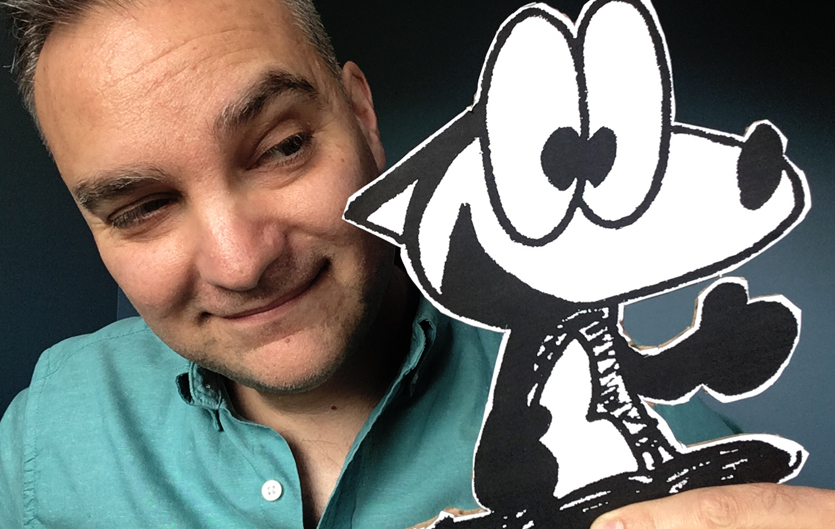
 About the Author: About the Author:
Daniele Rossi is a Canadian cartoonist who draws comics starring Franky Banky, a fox who stutters, and produces the Stuttering is Cool podcast, both inspired by his own experiences with stuttering. His work is used in speech therapy sessions worldwide to challenge stigma and help people who stutter build comfort in expressing themselves. Daniele had led cartooning workshops for children, adults, and speech-language pathologists at camps and conferences held by Can Stutter, Irish Stammering Association, STAMMA, and various Camp Dream.Speak.Live events, helping participants gain a more positive perspective on their stuttering while giving therapists a creative way to focus on the exploration of emotions in sessions. His comics can be viewed at frankybanky.com. |
A great way to see the different ways people perceive their stuttering (which I’d also describe as shades of stuttering) is by leading a cartooning workshop at stuttering conferences about drawing a cartoon character based on your stutter.
Long story short, I draw comics and graphic novels about stuttering featuring Franky Banky, a fox who stutters. Joining him is his sidekick, Ti-Ger, a metaphor of Franky Banky’s stutter.
Franky Banky is normally the star of my comics as I draw him dealing with speaking situations with confidence and humour. Stutter and all. It’s my way of spreading stuttering awareness while sharing my lived experience with stuttering with my fellow stutterers.
The star for this paper, however, is Ti-Ger, who you might have deduced is a tiger. I designed Ti-Ger’s personality around the characteristics of my stutter. Even his name is designed around my stutter — it’s spelled as a block! Ti-Ger is unpredictable, mischievous, and tends to unintentionally cause trouble. However, he is still a great companion to have. For example, my stuttering makes me appear more authentic when I don’t hide my stutter. I’ve found that fluent people in general appreciate this kind of vulnerability which makes them feel they can be vulnerable (and authentic), too. This is why Ti-Ger tends to also save the day in my Franky Banky comics.
Since I enjoy drawing Ti-Ger’s mischief in Franky Banky’s everyday adventures, I thought others may enjoy drawing their stutter as well. Thus, a few years ago I created a cartooning workshop to let other PWS design a cartoon character based on their own stutter.
I gave this workshop a few times and, initially thinking we will all have fun drawing bunnies and puppies, the outcome, however, have been incredibly profound:
- A man in his 50s drew his stutter as a “road closed” sign with an accompanying road crew member holding up a stop/go sign granting him permission to proceed with what he was blocked from saying.
- An SLP who stutters drew his stutter as an entity with many arms grabbing the letters or entire words he wanted to say. Even when he uses a stuttering modification technique or a trick like word substitution, one of the entity’s arms will still reach out and grab the substitution or his next intended word. Sometimes the entity simply hovers above his words or eventually moves farther away.
- A nine year old girl drew her stutter as a robot whom she named “The One-of-a-Kind Stammerbot 5000”. She shared with me that while she thought about how her stutter behaved like a robot that would get all stiff and can’t move when it runs out of oil. She gets all stiff and almost frozen, too.
- An SLP who sat in on my workshop gave this activity a try in a therapy session with an 11 year old boy. He drew his stutter as a cloud. He explained that sometimes it’s a friendly and calm cloud and sometimes it’s angry and “Stormy” and takes over. He also drew his cat who he cuddles to feel better during the stormy days.
- A friend who sat in on my workshop drew his stutter as an octopus with boxing gloves. He recently decided to get a tattoo of it!
For PWS, this activity has a powerful effect on changing one’s own perception of their stutter from being an adversary to a sidekick. This activity helps people:
- Think about their emotions and feelings towards their stuttering as they draw their cartoon character.
- View their stutter as something separate from themselves once they can visualise it on paper.
- Understand their feelings by naming something that bothers them.
- Reveal inner thoughts and worries by incorporating speech balloons and thought balloons. Drawing comics is also an excellent activity for this.
- Spread stuttering awareness! Showing your loved ones your character is an excellent way to explain what it’s like for you to live with stuttering everyday.
Even parents and families of children who stutter can benefit from this activity. The mother of an 8 year old girl who drew her stutter as a coffee-loving flying cupcake shared that viewing her daughter’s portrayal of her stutter gave the family a new way of looking at her speech. The mother also shared that the activity also gave her daughter a little more control of her stutter by giving it a name and a back story. She turned it into a little sidekick for her to take along with her for the ride!
The earlier-mentioned man in his 50s who drew the road block sign shared with me that the activity had him walk out of the workshop with a new, positive perspective towards his stuttering.
For the SLP, this provides a great activity to enable clients to reveal emotions towards their stutter that words alone may not be able to describe.
Seeing how unique each cartoon character participants create is a clear indication how the stuttering experience is, well, unique to each individual. Each of these characters became something more than a drawing. They become a way to name something that ails you and transform it into a companion instead of an adversary. That’s why I enjoy giving this workshop, handing people a pencil, and showing them how to draw their stutter.
Now it’s your turn. Grab a pencil, think about how your stutter behaves, and see what shows up on the page. You might be surprised at how differently you see it once you see it on paper.

Great article Daniele, I have a question. As one of the world’s leading creatives myself and a lecturer often I have students who say that they have no artistry skill or creativity. Of course we all know this is nor true. Everyone is an artist and everyone has ideas. How do you give people the confidence to hare their creativity?
No artistry or creativity needed. Even the simplest stick figures can be just as effective — and perhaps even more effective — than a fully rendered Disney or Marvel style character. The activity is not at all about character design. It’s about using doodles to depict and convey. Just like looking at prehistoric cave paintings. We can tell that the simple figures represent humans, different types of animals, and deduce their actions. Of course, we can’t interpret every figure on a cave but having the client with you in the therapy session to give a commentary on the cartoon that was just created helps! I’ve seen examples where the client wrote or typed what is going on or included speech bubbles and thought balloons.
Another benefit is when the SLP isn’t a perfect illustrator. Or can’t draw at all. When a client sees the SLP drawing not-so-greatly, the client will also feel less pressure to draw perfectly.
Side note: everyone can indeed learn to draw. Just start drawing and keep at it!
Nice to hear from you Rossi. As I teach people, as soon as you have a dream, a thought, a notion to simple move from chair to table…you are creative. Skill in drawing does not make an artist There is artistry in all that happens around us. In fact who decides what is good and not so good art. In the industry it is corporates. In reality it is inside you. When I script things I use simple stick figures. Often simply talking your ideas out to another is such an enjoyable experience. To be human is to be creative, to live a life is to be an artist. Some people just need the encouragement. You Rossi, are one of those rare natural muses.
Thank you, Daniele, your workshops have inspired a lot of people. (including me, as you know). It can be so incredibly helpful to draw your stutter and it really opens discussions about how people see their stutter and themselves! And it can help open minds to several options to cope with the feelings, attitudes and situations.
Manon
Thanks Manon! And so true! It’s amazing how much can come from a simple drawing.
Hello Daniele, Thankyou for yuor amazign paper and the insight you share. I also loved how you highlighted how people who may happen to have a stammer, can be creative in their own ways. For examples i feel that havign the opportunity to take part in the online papers, and other waysm helps us all.For example, i write poetry and stories, and i feel just beign able to express my self in this creative ways helps us to share the positive moments, and sometimes i have found it is the tricker moments, we may sometiems experience that also inspire us to be creative.You help so many of us.Your work shop also encouraged me to write more. THANKYOU .
I not sure i am allowed to write thsi on here, but i just wanted to say how much Grant Merediths comments also resonated with me. Daniel you open so many doors for us.
Thank you so much for the kind words Phyllis.
Hey Daniele,
Great paper and I’m so glad to read about how drawing stuttering can be so powerful and healing.
I really liked the example of the older guy who drew his stutter as a “road closed” sign with crew holding up signs for stop or slow.
You’re helping people of all ages, likely often without even knowing it.
What has surprised you most in the evolution of Franky Banky and Ti-Ger?
Thanks for all you do for the community.
Pam