
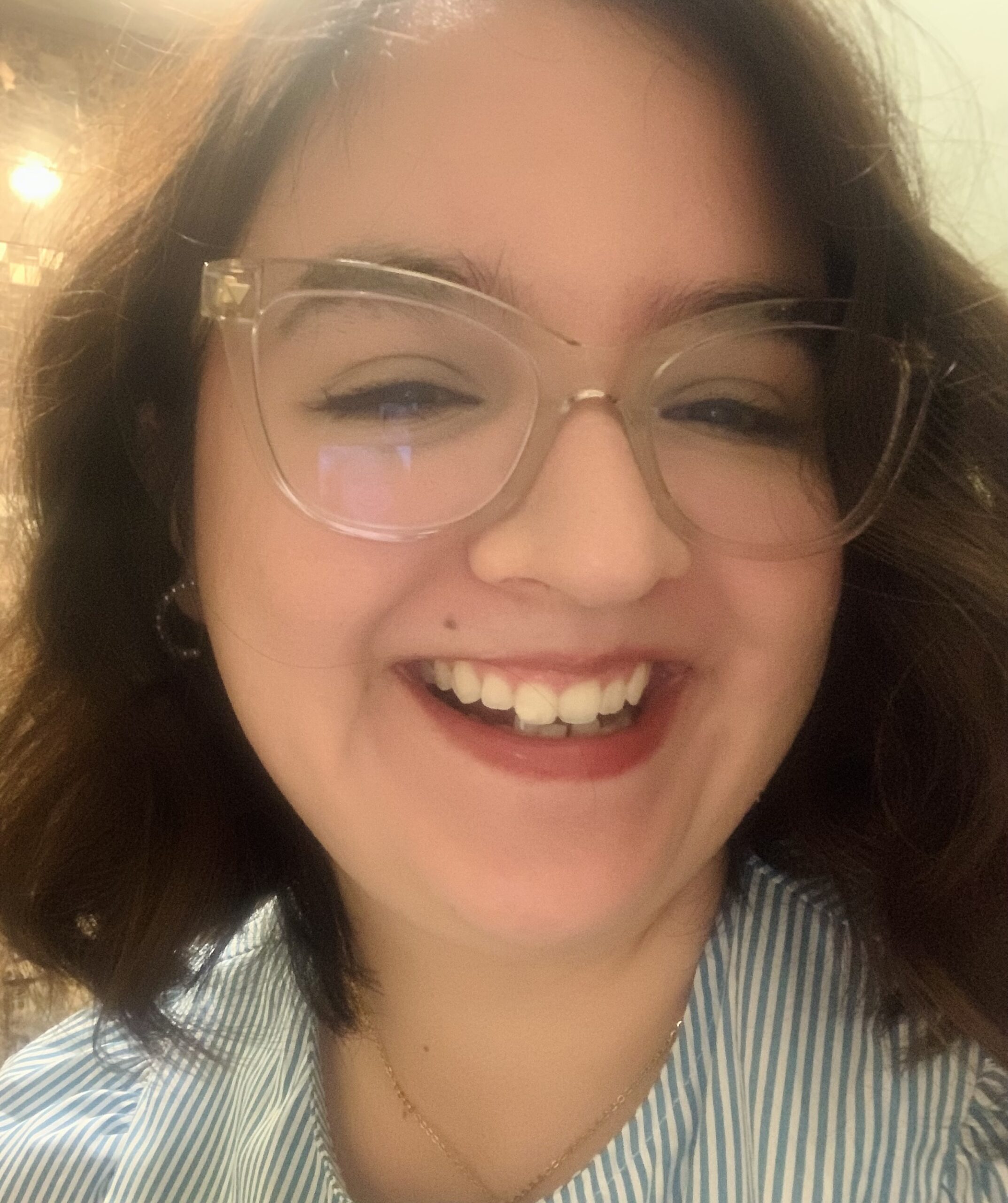
 About the Author: About the Author:
Sara Ayala is an educator from Houston, Texas, who is passionate about helping others and making a positive difference in the lives of those around her. As a person who stutters and a member of the stuttering community, she values meaningful connections and the power of using her voice. Outside of her work as an educator, Sara enjoys traveling, reading books, having deep conversations, and singing karaoke. She believes that every person has a unique story and voice worth sharing and continues to embrace her own voice throughout her stuttering journey. |
About a month ago, I went on a mission trip to New York City. I remember feeling excited, but also really nervous.
For a long time, I didn’t go to many group gatherings unless they were related to stuttering, like events with the National Stuttering Association (NSA). There was a comfort in being around other people who stuttered. I didn’t have to explain myself. If I blocked, repeated a sound, or took longer to say something, I knew the people around me understood.
But recently, I had started pushing myself to do more things outside of the stuttering community. I started saying yes to things I had always wanted to try, like taking a salsa class or joining a book club. They may seem like small things, but for me, they were steps toward putting myself in situations where I didn’t know how people would react to my stutter.
So when the opportunity came to go to New York, I wanted to go.
But that didn’t mean I wasn’t nervous.
One of the things I worried about was something most people probably don’t think twice about: introducing myself.
“My name is Ssss-ara.”
My own name can be difficult for me to say.
There is something vulnerable about stuttering on your name. You can’t substitute another word for it. You can’t avoid it. Everyone is looking at you, waiting for you to say the one word that should belong to you more than any other.
Sara.
Before the trip, I wondered what it would be like introducing myself to a whole group of strangers. Would I block? Would someone try to finish my name for me? Would there be that awkward silence while they waited?
It turns out that once I arrived, introducing myself became the least of my worries.
I was in New York City!
I remember looking around and taking everything in; the buildings, the noise, the people, and the constant movement. There was this hustle and bustle everywhere I went. I loved seeing how diverse the city was. I saw Dominican, Vietnamese, Puerto Rican, Chinese, African American, and so many other people and cultures all sharing the same city.
I visited places I had seen so many times in pictures: Times Square, the Statue of Liberty, and The Edge, where, of course, I had to take plenty of pictures!
But out of everything I saw in New York, one of the places that stayed with me the most was the 9/11 Memorial & Museum.
Walking inside felt completely different from walking through the busy streets of New York.
It was quiet.
It was a place where I could slow down, contemplate, reflect, and remember the lives that were lost.
As I looked at the artifacts, I came across a giant wall that, from afar, looked almost like hundreds of blue sticky notes. As I got closer, I realized they were different shades of blue placed closely together, creating a beautiful mosaic.
I later learned that the artwork, created by Spencer Finch, is called Trying to Remember the Color of the Sky on That September Morning. It is made up of 2,983 individual watercolor squares, each a unique shade of blue. The different shades reflect the idea that our perceptions of color and our memories can differ, even when they share a common point of reference.
As I stood there looking at all those shades of blue flowing together, almost like waves in the ocean, I began thinking about something else: the shades of stuttering.
Of course, I don’t compare the experience of stuttering to the tragedy and loss of September 11. Instead, seeing so many different shades represented side by side made me think about how differently human beings can experience something—and how those differences can exist together.
There are so many of us who stutter, yet none of us stutters exactly the same way.
Some of us are covert stutterers and may go to great lengths to hide our stuttering. We might change words, avoid saying our names, order something different at a restaurant because the word we actually want feels too difficult, or simply decide not to speak at all.
Some of us block.
Some repeat words, syllables, or sounds.
Some of us prolong sounds—“Ssss-ara.”
And for many of us, it’s a mixture of all of these things.
But the different shades aren’t only about how we stutter. They are also about how we feel about our stuttering.
Some people have reached a place where they accept their stutter and speak freely without shame. Others are still hiding it. Some are trying to accept it but still have difficult days. Some may feel confident one day and frustrated the next.
I think I’ve experienced different shades throughout my own journey, too.
There have been times when fear of stuttering made me want to stay within the places where I knew I would be understood. And now, I’m learning to walk into new spaces anyway.
A salsa class.
A book club.
A mission trip.
New York City.
A group of strangers waiting for me to introduce myself.
And yes, sometimes that introduction might begin with:
“Ssss-ara.”
But it’s still my name.
Standing in front of those shades of blue reminded me that something doesn’t have to be exactly the same as everything around it in order to belong.
Every shade on that wall was different, yet together they created something beautiful.
Maybe our voices can be that way, too.
There isn’t one correct way to be a person who stutters. Your journey doesn’t have to look like mine, and mine doesn’t have to look like someone else’s.
Maybe you’re completely open about your stuttering.
Maybe you’re still hiding it.
Maybe you’re just beginning to say your name without trying to escape the sounds you fear.
Wherever you are right now, your shade belongs.
Our voices don’t have to sound the same to have value. They don’t have to be fluent to have something important to say.
Whether the words come easily, whether they repeat, whether they stretch, or whether they take a little longer to come out, they are still ours.
And just like those many shades of blue, there is room for all of us.
There is room for your voice.
There is room for mine.
We are worth listening to.
Reference
National September 11 Memorial & Museum. (n.d.). Trying to remember the color of the sky on that September morning. 9/11 Memorial & Museum.

Oh Sara – this is so stunning!!!! I can feel every word, and connecting the shades of 9/11 sky-blue to shades of stuttering is such a potent image. Thank you for being a beautiful human being who makes room for all of shades.
Kimberly
Sara,
This is a truly amazing piece! You paint such a clear illustration of how different shades can conjoin and create beauty.
And you have created quiet beauty in your life, and the lives of others, by the chances you are taking. Stepping out of your comfort zone time and again is helping you grow in leaps and bounds and it’s wonderful to pay witness to that growth.
Thank you for sharing. I hope you seize every opportunity to introduce yourself to every potential new friend. I look forward to one day attending a virtual or in person session that you facilitate on stuttering, change and growth.
Pam
Hello Sara, I love this perspective and how you didn’t let your fears stop you from experiencing new places and new hobbies. I know this much have been a hard thing to initiate because it can be easier to avoid things rather then experience. I love that you gained this perspective of different shades of voices because it is so true. Not one person sounds the same, stutters the same, or even acts the same. Everyone has their own perspective. I am so glad that you shared this perspective and it really opened my eyes as a graduate student who is learning about fluency.
Thanks for sharing this experience, Sara. It sounds like a beautiful journey and I’m glad New York has been a wonderful opportunity to put yourself out there more.
Sara, I appreciate you sharing your story. You wrote a beautiful essay that encompassed such a wide range of emotions within your trip to New York City. The closing line, ‘We are worth listening to,’ especially resonated with me. It’s a message I hold close to my heart, and you stated it so powerfully.
Best Regards,
Maggie Ritchie