
 About the Authors: About the Authors:
Voon Pang is a speech-language therapist at Skill Builders Speech Language Therapy in Auckland, New Zealand. He dedicates his summers volunteering for the Stuttering Association for the Young: Australia (SAY: AU) during their week-long, overnight camp in Melbourne, Australia. Since 2011, Voon has worked for the Stuttering Treatment and Research Trust, the Ministry of Education, and the University of Auckland. He embraces holistic, comprehensive therapeutic frameworks which support positive stuttering identity. He considers himself a stuttering ally and his work is inspired by his friends and colleagues who stutter as well as the clients and families he serves.
|

Acceptance has become a common theme in Western culture and the variety of definitions and particular emphases has grown along with the concept’s prominence. To some, it may mean throwing one’s hands into the air, giving up. To others, there may be a sense of pride and value in what is being accepted. For our purposes, we can offer a simple definition: embracing reality without surrendering. This allows room for living in the moment rather than putting life on hold while continuing to pursue the things which matter most (which may or may not involve pursuing change). What we hope to lay out is a broad pathway for considering choices closer to and farther away from acceptance. Deep and meaningful change of all types can vary in as many ways as there are people. What matters is knowing a pathway exists and having the support to walk it when desired.
For people who stutter (or stutterers), one form of acceptance involves the way they speak. Eric Jackson, a researcher with a focus in stuttering at NYU (and a person who stutters), provides a helpful frame for this: “When speakers are less preoccupied with how they are being perceived and less flooded by shame-based predictions, more attentional bandwidth becomes available for the actual task of speaking. In that state, using forward-moving speech, easy onset or light contact, or pausing/phrasing is less likely to feel like an emergency maneuver to prevent judgment and more like a deliberate, flexible choice to reduce struggle and stay engaged.” Another way to put this is that acceptance can free someone of the weight of their own and others’ judgments. Dr. Jackson goes on to say, “Self-acceptance does not replace speech work; it changes the conditions under which speech work becomes usable, sustainable, and less costly.”
In application, acceptance can be both challenging and rewarding, and walking through this process can yield increased confidence and a sense of agency. It is learning to drive with stuttering in the passenger’s seat, a companion rather than an impediment. But what if you are along for this ride, strapped into the back seat? Stuttering offers its own journey for friends and family, its own pathway toward the reality of this impactful difference. Having discussed our own perspective for considering acceptance, we will shift to the family in two forms: parental and environmental considerations.
Parental Acceptance
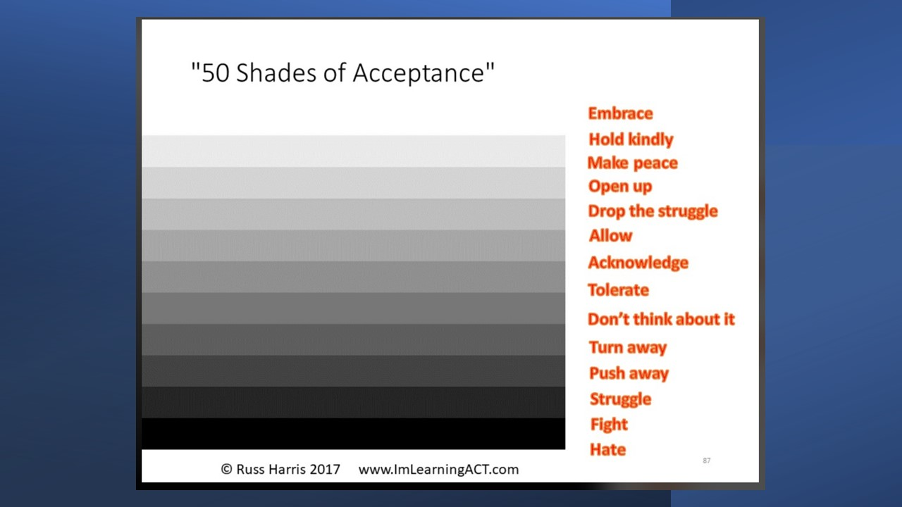
As a parent of a person who stutters, you may or may not consider yourself to be on your own journey but you absolutely are. You have your own experience of stuttering and have likely felt its impact on your life in unique ways. You are likely somewhere on the pathway of acceptance and that may or may not be where you want to be. Do you acknowledge stuttering and talk about it in a matter of fact way? Do you push it away and try not to worry about it? Or are you further along in your journey and have made peace with it (however you define that), perhaps even embracing it when you know that seeing your child stutter openly means letting go of the need to control (stuttering) and speaking with spontaneity?
You may choose a different set of words than Russ Harris’s graphic to describe your pathway or you may find some of the terms serve as a helpful starting point. If you are helping someone on this journey but are new to this topic, a good way to begin is by considering where you are now. When he or she stutters, what is your first thought? What is your body’s reaction? Is your relationship with stuttering one of pride, support, neutrality, concern/worry, embarrassment, or even hatred? You may strongly dislike some of those words and that is OK. If so, which words would better suit your feelings?
It is important to make room for these feelings – we cannot work through what we will not acknowledge. These feelings are normal and quite common. They speak to the deeper hopes you have for your child, grandchild, nephew/niece, or friend. They speak to the way you think of their future and what you believe to be possible for them. As you take stock of these thoughts and emotions, would it be helpful to discuss them with someone? A friend or therapist can come alongside to work through them. Deciding where you are is the first step. The second is to decide where you want to be. You might be intrigued by the term “hold kindly.” Helping someone on their journey can include something as simple as considering what a small step toward “hold kindly” might look like or asking, “have you ever held stuttering “kindly” before? How did you do it? What did it feel like? Give yourself permission for taking small steps. You can have this same conversation for “tolerating,” “acknowledging,” and “allowing.” Think of these terms as steps in a direction. Could they be possible for you or your child and what would that be like?
Outdated research years ago implied that parents were the source of their child’s stuttering. Fortunately, times have changed and are continuing to change. Stuttering is no one’s fault. So when it comes to a parent or caregiver’s role, it is best to think of the positive influences you can have. Children, after all, follow their parents’ beliefs and where we can model for them that they can communicate wonderfully with stuttering, tell stories (with stuttering) that capture our attention, give presentations with stuttering, talk on the phone and stutter, and order exactly what they want, stutter and all, they will often adopt your mentality and be more open to your attitudes, particularly at the younger ages. Regardless of age, the impact of social acceptance is difficult to overestimate.
We can apply these concepts in the actions we take and the words we choose. Kelman and Berquez (2018) discuss the contributions of “value-laden” language to the black-and-white dichotomy that fluency is “good” and stuttering is “bad”. When your child approaches a difficult speaking situation, what do you tend to praise? Is the “win” how fluent they sound or the amount of courage it took to speak? For example “he spoke in front of his class and he did so well that he didn’t stutter once”. As humans, we are all prone to using evaluative language and “short cuts” to describe our experiences and the experiences of others. Consider this experiment where someone asks you, “how are you doing?” What is your automatic response? We usually offer the path of least resistance by saying “good” or “bad” but then go on to describe our experiences which add more shades of meaning and context to how we’re feeling. There is nothing “good” or “bad” in how we respond in these everyday interactions; however, when it relates to stuttering, it makes a positive difference to model language which is less judgemental so that the child will have a positive view of themselves as a communicator, irrespective of the level of stuttering or fluency. Rather than describe fluctuations in stuttering as “good” or “bad,” that your child’s stutter is the “worst it’s ever been,” or ”he’s going through a bad patch,” consider more neutral and descriptive language by using terms such as “more frequent or higher periods or levels of stuttering” or there were “more struggled moments” this week rather than defaulting to it being a “bad” week. Higher levels of stuttering do not have to be “good” or “bad.” This simple adjustment in language supports a shift in what is valued. As our mindsets begin to change (reflected in the language we use), you might discover that your days do not rise and fall on stuttering or experienced fluency. These changes may feel awkward at first and you may not use the exact phrases we have offered, but perhaps they are worth experimenting with. When undertaking long-term change, it usually takes more time to notice the differences.
Environmental Acceptance
We would like to begin environmental considerations with a metaphor we like that speaks to the feelings of being the only one who stutters and/or without the support system they need. The Japan metaphor was created by Jodie Wassner, an educational and developmental psychologist from Australia who works with neurodivergent children to help them find meaning and connection in a foreign context. We think this metaphor may be useful for young people who stutter who are trying to navigate a fluency-dominant world (moving to and living in Japan) and finding a place to belong. We also think this metaphor applies to the parents of young people who stutter where navigating and understanding stuttering culture and customs takes time.
Japan Metaphor
Imagine that you decide to move to Japan. You are interested in so many things about Japan, including the lifestyle, the technology, the train systems. You spend months learning the language, reading up about customs and learning about the food. You arrive in Japan and find your way around pretty well, enjoying many of the things you have researched. There are times, however, when you make mistakes. You might misunderstand a Japanese custom and carry it out incorrectly. Maybe you bow too low or you don’t bow low enough to someone you have met. You would probably make some language mistakes too and realise that your Japanese will never be as fluent as English.
Life in Japan will never feel as natural and as easy-going as it might in a country that you’re more used to. Eventually, you meet other English speakers living in Japan and you are able to spend relaxed time chatting with them. You also meet some Japanese people who are fascinated by Western culture and want to learn English. They love your difference and are keen to enjoy your company. Over time, you find a way to have a meaningful life in a place that can, at times, be confusing.
After reading the Japan metaphor, what resonated with you? What didn’t? Are you on a path of connecting with people you can relax and chat with who speak the “same language” as you, who have similar stuttering experiences? Or have you met people who are different from you who are fascinated by stuttering, want to learn more about it and embrace stuttering culture and “norms”? Thinking back to stuttering acceptance, what small steps have you taken to surround yourself with a supportive environment? We believe that finding like-minded people, having a sense of community, and a sense of belonging, increases stuttering acceptance. Research also supports this. It has been found that people who stutter who participate in social support groups (as well as their parents) experienced greater acceptance (Gerlach et al. 2019, Ferguson & Arenas, 2020, and Boyle et al. 2018). For those interested in immersing themselves in a stutter-friendly environment, there are many self-help and stuttering social support organisations available (FRIENDS, National Stuttering Association, Stuttering Association for the Young, Spero Stuttering, and the Stuttering Foundation).
Conclusion
Think of acceptance as embracing reality without surrendering, a pathway to explore communicating with joy and comfort. Helping a child who stutters is so much richer than finding the secret to fluency. There are so many ways to help, from creating spaces where your child can stutter freely to entering supportive stuttering communities, where acceptance can begin to “rub off.” Acceptance is bidirectional, after all. Not only can you and your child move toward acceptance of stuttering, the culture around you bears a significant responsibility to validate the value and beauty of stuttered voices. Lastly, it’s important to acknowledge how difficult the process can be and the grace needed for your child and for you throughout the process. It’s OK to be where you are. It is a place in time, a mark in your journey, and perhaps an opportunity to reflect on how far you have already come.
References:
Berquez, A., & Kelman, E. (2018). Methods in Stuttering Therapy for Desensitizing Parents of Children Who Stutter. American journal of speech-language pathology, 27(3S), 1124–1138. https://doi.org/10.1044/2018_AJSLP-ODC11-17-0183
Boyle, M. P., Beita-Ell, C., Milewski, K. M., & Fearon, A. N. (2018). Self-Esteem, Self-Efficacy, and Social Support as Predictors of Communicative Participation in Adults Who Stutter. Journal of speech, language, and hearing research : JSLHR, 61(8), 1893–1906. https://doi.org/10.1044/2018_JSLHR-S-17-0443
Ferguson, K. A. & Arenas, R. (2020). “The Experience of Being a Parent of a Child Who Stutters and Subsequent Involvement in Support Groups: A Narrative Study.” https://digitalrepository.unm.edu/shs_etds/28
Gerlach, H., Hollister, J., Caggiano, L., & Zebrowski, P. M. (2019). The utility of stuttering support organization conventions for young people who stutter. Journal of fluency disorders, 62, 105724. https://doi.org/10.1016/j.jfludis.2019.105724
Jackson E. S. (2026). Fluency Should Not Be a Goal in Stuttering Therapy. Journal of speech, language, and hearing research : JSLHR, 69(7), 3116–3126. https://doi.org/10.1044/2026_JSLHR-26-00111

Hello, I was so moved by your paper. As a mother of a teenager who stutters, I deeply resonated with so much of what you wrote about. Thank you for your encouragement, grace, and affirmation to all of us on this journey of acceptance. Well done!
Thank you for the encouragement, Arin, and for the reminder to approach families from a place of encouragement, grace, and affirmation. We therapists need regular reminders like your response provides.
Hi Arin, thank you for your kind words. I will always remember our first meeting when the pandemic hit and your openness and kindness with connecting on zoom with one of the parents I was working with (and her 7 year old son) made such a difference. I hope we get to meet in-person one day!
Thank you, Daniel and Voon, for this thought-provoking article! I’m imagining all the fear, pain, and heartache we might avert (or at least subdue) if living by this mantra – “embracing reality without surrendering” not only in relation to stuttering but also life in general. How many realities do each of us face that require openness, flexible choice, perspective, adjustment, change! But as you rightly stated, “we cannot work through what we will not acknowledge.” Thank you for causing us to reflect on how to pursue the things that matter most!
Thanks, Ana Paula. I continue to learn acceptance in my own life which has made me a little more open to change and adversity over time. It seems the wish to avoid discomfort might be what shields us from seeing the potential growth on the other side.
You summarized us very well and I know that is because you are such a good listener. So grateful you took time to read the article and share your reflections!
Thank you Ana Paula for your comment and reflection. I think as we embrace reality without surrendering helps with being more flexible and working alongside difficult feelings. I’ve learned from many families and professionals like yourself that moving in a direction despite pain and hurt can open up new learnings and opportunities and it’s only upon reflection that we realise how far we’ve come (when we take time to look back).
Thank you so much Daniel and Voon for this important piece.
I’m a PWS who tried to hide my stuttering for 35+ years because of early shame experiences as a result of how my father reacted to my stuttering.
After a long journey of hiding and then “coming out,” I’ve learned a lot along the way. Including not surrendering to the reality that I stutter. People look at me like I’m a nutcase when I now sometimes will say, “Wow, I just stuttered really well.” I’ve had PWS ask me why I say that and encourage them to consider it too.
I stutter. I’m going to stutter. I’m good at it – I’ve been doing it for my life time. It’s hard for people to react poorly to me when I’ve just acknowledged my stuttering with a smile.
Do you think parents would be open to encouraging their kids who stutter to sometimes just smile and say, “Wow, I just stuttered so well?”
Pam
Thank you for reading our article, Pam, and sharing the enormous shift you made after receiving those early messages about stuttering. I cannot imagine the pain you walked through for many years as a result.
I have been encouraged as I think of the many families I have met over just the past five years who are open to seeing stuttering from another vantage point and shifting their supports, regardless of their starting point when we met. I see that as a positive sign of an openness to considering stuttering as another difference like hair color. I hope we can continue to encourage and support families on this journey to know that acceptance is one way to help their child and it is “doing” something. A huge something!