
 About the Author: About the Author:
Joeri van Ormondt, MSc, SLT, CESS-certified stuttering specialist from The Netherlands, owns private practice De Stotterpraktijk, specialised in stuttering and cluttering. He is a person who stutters. He co-founded Stotterconnect, an organization dedicated to Camp Dream. Speak. Live. and the training of SLT’s. |
The last few years I have been scared. Scared to open up about stuttering. Scared to say something about my own journey with stuttering. But only in a specific situation: among fellow SLT stuttering specialists. With all of them? No, absolutely not, there are shades to this. This summer, I found out—in two acts—what makes the difference for me; and how people who stutter would benefit from a change in our profession.
Act 1
I was asked to take part in a panel discussion at an international conference for SLTs to talk about my personal journey with stuttering. The conference was nice, well organized, and had different perspectives represented. Yet the question triggered so many thoughts and emotions. As is so often the case with stuttering, it was because of my lived experience. In the past, I’ve had colleagues say (out of nowhere) to me: “realise that not everybody stutters the way you do”, “your journey is different from other people’s journeys”, “because you stutter you are biased”, and “you have too much personal involvement”. If they had observed me conducting therapy and afterwards told me that, that would be one thing, but they told me this based solely on the fact that I stutter. And that is stigma. Stigma within some parts of the professional field, where at the same time we are trying to help people who stutter get rid of stigma.
The stigma became self-stigma. Telling an audience of professionals about my journey, I figured, would give them something to come back at me over what I advocate for regarding therapy preferences and stuttering pride. The question is: is there actually (self-)stigma or am I oversensitive? I remembered a story from an SLT who has a child who stutters and gets the same reactions. At the same conference Mandy Rodstrum, an SLT who stutters, gave her keynote about roughly this topic. So that’s two other experiences. To be sure, I reached out to some other SLTs who stutter. Some told me they had not experienced this to the same extent. However, quite a few comparable stories came in: being warned that their experience does not apply to everybody. Or that it is easy for them to talk about acceptance, because they are perceived as not stuttering very much. Some colleagues feel like they have to be very careful about how they talk about their own experience with stuttering in professional settings. Some just avoid it. In journalism, when three sources point in the same direction, there is a story to be told. Reaching out already gave me way more than three indications that it does not always feel safe to be your full self.
Act 2
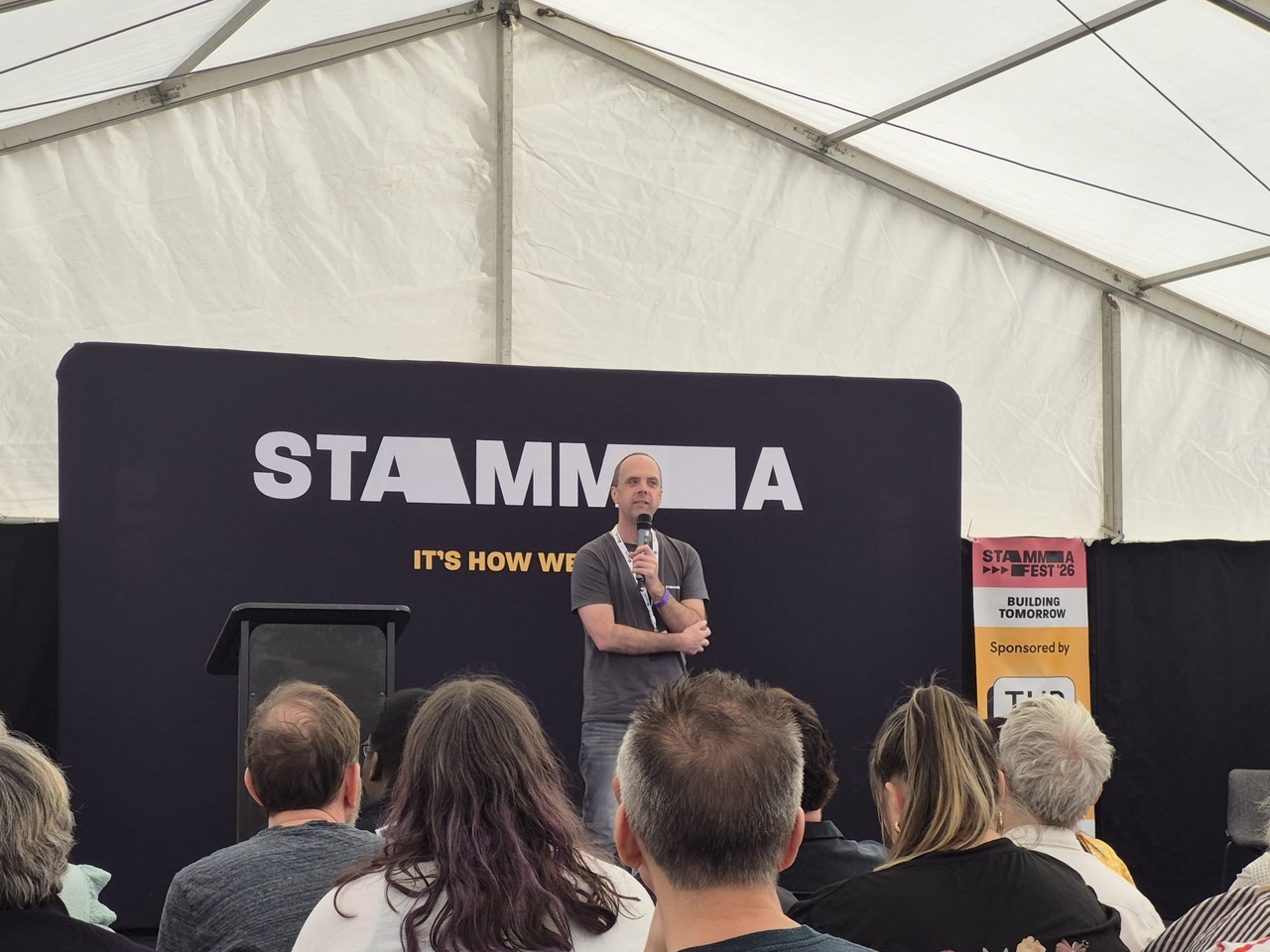
Fast forward to the second conference I attended this summer, Stammafest. Being there made me realize, “Hey, had the panel been here, I’d feel different.” I even tested it during the Open Mic. What’s the difference? Although Stammafest is focused on people who stutter, there are also lots of SLTs there. Both conferences are open to a broad spectrum of views. “Stammafest is all about connecting with your ‘tribe’,” says the booklet. During the conference I met several SLTs; they all told me: “I’m looking for ways to improve my approach to therapy. I’m here to learn.” And of course, that’s it! The SLTs came to learn from people who stutter. They not only want to hear from clients who come to them because they experience difficulties or negative impact, but also actively seek out people who are in a good place with their stuttering. Some colleagues might have the impression that it’s only people who embrace stuttering pride. But it’s not. The full spectrum of opinions is present.
Being there makes me wonder: where would an SLT, whether new or experienced, learn more? An environment built around lived experience, or, like some stuttering therapy courses, an environment shaped by top-down theory and recommendations for assessment and therapy?
Scared
I am not scared anymore, thanks to those strong voices. Seeing Mandy’s strong keynote, attending Stammafest, and reading a colleague describe how they feel they have to walk on eggshells in professional settings while still sharing their personal stories, made a difference. I have heard about SLTs who stutter leaving the field, and that’s such a waste. Let’s speak up more, and create that snowball effect for other SLTs who stutter and want to speak up too.
This is a call-out to all SLTs, whether they stutter or not. Reflect on whether you are on an island: Have your views on stuttering changed in the last 10–15 years? Do you regularly talk to people who are in a good place with their stuttering and/or do you attend community-driven* events? Do you consider concepts like little-t trauma, micro-aggression and ableism relevant to stuttering therapy? Have you participated in workshops on aspects of stuttering you are less familiar with, such as identity, stigma, representation, neurodiversity-affirming therapy, intersectionality, pride, or privilege? Do you believe that stuttering can genuinely add something positive to a person’s life? Has your therapy, teaching, or research changed substantially in the last 10–15 years?
Paradigm shift
If you answered “no” to several of those reflection questions, help change the field for the better. There really is a paradigm shift happening that you might be missing out on. “Change how?” you might wonder. I think therapy, teaching and research (and the people working in these fields) as a whole should be heading towards a strong, ongoing, and ever-evolving collaboration with the community: with people who stutter. Two decades ago, therapy was mostly professional-led, with little connection to the lived experiences of people who stutter. Some now argue that the community should take the lead entirely, making SLTs obsolete. I believe the way forward lies somewhere in between: a genuine and equal collaboration between professionals and the stuttering community, where lived experience is truly incorporated into therapy, teaching and research.
Become a true ally. Let go of the myth that stuttering and other ways of talking orbit around fluency. Go to a community-driven event. Just reach out.
*Examples: Stammafest, Stamily Youth Exchange, Friends, NSA-events, etc.
Many thanks to colleagues that shared their story, and to the people who proofread the draft: Anne Bakker, Femke de Smit and Mandy Rodstrom.
The framing of being “scared”, as well as the “orbit around fluency” metaphor, was inspired by Anne Hathaway’s speech at the 2018 HRC National Dinner.
- ChatGPT was used for spelling and grammar checks, since English is not my native language.

I’m pleased that you found the experience at Stammafest comfortable. However, if “the community should take the lead” then what about communities such as the McGuire Programme, or other groups who want to stutter less or even remove stuttering entirely? Should they take the lead as well?
Such groups are in many ways the opposite of what is promoted at Stammafest, yet they are also people who stutter who believe earnestly in the paths they have chosen. Who should SLTs listen to? How can we make things equitable for all people who stutter, and not just the ones we happen to agree with?
Dear Max,
Thanks for your reply.
I think it’s always important to be in touch with all voices or opinions. A core skill of an SLT is (or: should be) shared decision making. To do that properly both SLT and client should be informed about different options.
As I was trying to say in the article, I think not the profession nor the community should take the lead. It’s about the joint effort. Where all opinions matter just as much; whether you’re seeking stuttering pride or fluency shaping, and everything in between. Key is, I think, to be informed on pros and cons on all options; so the person who stutters can go on their path, step by step, going back and forth, left and right. All is good, it is your path.
Thanks Joeri! I agree, joint effort and informed choice of pros and cons are what is needed.
👍 Great to hear Max!
You imply that StammaFest promotes acceptance of stammering. This is not true.
Stamma is a broad church. It lists the McGuire Programme on their website. Empowering Voices, which uses the McGuire technique, ran a workshop at StammaFest.
SLTs do not listen to McGuire, perhaps because the central premise of his technique – that fear causes stammering – is not true. I also do not think that some of his statements about the workings of the diaphragm are true either. Remember that McGuire learnt all he knows about the diaphragm from the Del Ferro Institute – who currently claim that you can achieve fluency in one day!
There is nothing inherently wrong with wanting to stop stammering or wanting to stammer less.
This is recognised in the ISA Declaration of the Right to stutter – “as individuals we may wish, or even try” (to overcome our stutter).
I have wanted to stop stuttering all my life using avoidance – and have failed miserably! I would have been better accepting it?
Tim – Although both organisations represent people who stutter, their messaging is inconsistent. For example:
• Slogans: Stamma has “It’s how we talk”, McGuire has “Beyond Stuttering”.
• Homepage: Stamma has “We Make Space For Stammering. We Celebrate Different Voices”, McGuire has “Struggling with Stuttering? Take Control of Your Speech Today”
These perspectives on stammering are opposed.
What would an organisation look like that represents everyone who stammers? How can activism be equitable?
Stamma represents all people who stutter. The McGuire Programme only represents its own graduates. Their messaging is naturally going to be inconsistent.
Stamma’s perspective on stammering is that society should have more understanding, and less prejudice and discrimination. Stamma has no perspective on how any individual deals with their own stammer.
The McGuire Programme’s perspective about stammering is that it should be overcome, as an opponent or enemy of the individual. As far as I am aware it has no social perspective.
I am not sure that any organisation can represent ALL people who stammer. I think there are flaws in the current concept of a broad church or the ‘stammering community’ in general. What does a proud exponent of open stammering have in common with a graduate of the McGuire Programme. The successful McGuire graduate does not need representing in society because he has achieved fluency. The successful open stammerer does need representing in society and protecting from still existent misunderstanding, prejudice and discrimination.
I sometimes find Stamma messaging confusing. Perhaps this is because they promote acceptance of stammering to society, yet recognise that all people who stammer do not want to accept their own stammer. Perhaps the answer could be three organisations – one for affirmers, one for deniers and one for inbetweeners!
Thanks Tim, I agree with a lot of what you’re saying. This includes the comments about the McGuire therapy programme – it can be great for some, but I’d strongly recommend that anyone who stutters consults with an accredited SLT before considering user-led stuttering intensives of this nature. However, the desire for such intensives is instructive. It suggests that, for some people, their needs aren’t being met by the SLT services available to them. This warrants attention from anyone concerned about the welfare of those who stutter.
It’s worth noting that Stamma does not represent all people who stutter. Its membership is 500,000 adults who stutter. Thus it can claim to represent at most 1% of people who stutter – actually less, since many members are SLTs or parents.
Stamma promotes itself as the UK’s national stuttering charity. As such, it has a responsibility to at least attempt to be representative of all who stutter, which I think is what you were getting at. As I’ve described, its messaging does not meet its stated aim of being a “broad church”. It did better with messaging when it was the British Stammering Association, since treatment of opposing viewpoints was more even-handed.
A national organisation representing those who stutter should be inclusive of the very wide range of attitudes they hold. In choosing to focus on the “successful open stammerer [that the charity proposes] does need representing in society”, Stamma can leave many who stutter under-represented or, worse, misrepresented.
Edit: I meant to write that the Stamma membership is at most 5,000 of the 500,000 adults who stutter in the UK. If Stamma had a membership of 500,000 PWS we would be having a totally different conversation !!!
I think the membership is more like 5,000!
I think they can only represent the members they have – which are growing.
I understand your perceptions but don’t agree with them all. I think they are trying to be a broad church inclusive of costal breathers. There could be a misperception that they are a woke/pc organisation.
Tim – I think our messages crossed, lol!
The Stamma membership grew very quickly in its early years. However, that was driven by them cleaning out their database and requiring everyone to re-register. I think Stamma membership has been fairly static in recent years, about as many joining per year as are lost due to attrition.
In some ways, Stamma provides a useful case study – refocussing campaign messaging towards a social model of stuttering did not uncover a large untapped demand for social model portrayals of stuttering. Rather, membership remained ~1% of adults who stutter, similar to with the old British Stammering Association messaging. Compared to other countries I suspect this might be universal – perhaps only about 1% of those who stutter are seeking out others who stutter at any point in time.
In advocacy, my main concern is those experiencing distress or disadvantage due to stuttering. Some of them find support in stuttering communities, but most people who stutter never engage with those communities, and those who are struggling among them are reached mainly through public messaging. For them, messaging can be critical. It would be great if Stamma pursued a genuinely “broad church” messaging strategy, but that would look quite different from its current campaigns.
Hi Tim! I agree about the ‘broad church’, that why I wrote: “The full spectrum of opinions is present”. I think it’s important to recognise that whatever works for you works! Thanks for sharing your thoughts!
Hi Joeri,
As an SLT who does not stutter, I learned so much from my clients and from the conferences with people who stutter I attended. I learned the most when I was talking to people who stutter. As you say in your comment to Max Gattie: it is about joint effort, but listening to the real experts (the people who stutter), I learned to listen even more and addapt the shades of therapy to the indvidual wishes and needs of the person that is sitting infront of me.
I can imagine it can be hard to let go of your own opinions and experiences as an SLT who stutters as well, but it is so encridubly valuable to everyone to share them.
Hi Manon, Thanks so much for sharing your insights!
Hi Joeri
Thank you for writing this important paper. I was with you at both conferences, and, although I am not an SLT, I completely understand your position.
You ask: “where would an SLT, whether new or experienced, learn more? ” Again, having been at both conferences, I have no doubt at all that an SLT would learn more at a conference of the STAMMAFest type. That is not to say that there is no room for academic conferences: of course there is. Also, there are many “shades” of academics and researchers, such those who interact with our community and those who hold themselves separate.
I really value those SLTs who do not stutter who attend both types of conferences when they are able to. Many of them are treasured mutual friends of ours. I attend both types when I am able to. Together, we discuss and we learn.
Your experience reminds me of one of my own: at an ISAD event in 2019 where I hosted a public screening and discussion of “When I Stutter”, I was asked whether a PWS can be an SLT. I answered in the affirmative, of course. Just as a physically disabled person can be an orthopedic doctor, a PWS can be an SLT. one non-stuttering researcher and SLT stated that, no, that is not possible. One first needs to “fix” oneself before helping others. And therein lies the problem: the belief in certain circles that stuttering has to be fixed. That said, stuttering is complex and there are aspects that are simply a part of us and other aspects that result from stigma, fear, and shame. The latter can be understood and sometimes we can let go of the struggle that results from them, and we can stutter more easily, more naturally, in fact. I know that I am not writing anything new to you.
I am really sorry that you experience that absence of safety in some settings. If you can, please continue to attend those events and to speak up. When I can, I will be there with you. Your message is important, and the way you express your message is invaluable. You invite and enable discussion.
Thank you
Hanan
Hi Hanan,
Thanks so much for you extensive reply and thoughts! I’ll try to reply to everything you’re saying:
I agree, professional conferences are really important too. For arguments sake I made the difference between the two a bit bigger, to get my point across. But I do underline the importance of professional conferences as well. We learn everywhere, as you say, and a broad range of conferences really helps to sharpen your mind!
That’s -unfortanately- a great example of what I meant to say in the article. In some circles the focus on fixing still comes first; mostly a bit hidden in the minds of people. Luckily lots and lots of SLT’s think differently, or starting to think differently.
It’s always great to have you by my side, and yes, I will keep speaking up. Not always easy, but I find it important; as long as it enables discussion. Thank you so much for acknowledging that it does!
Joeri, thank you for writing this valuable piece. I really appreciated the questions you challenged SLTs to consider, like whether our thinking about stuttering continues to evolve, whether we are learning from community spaces, and whether issues like stigma, ableism, identity, trauma, and neurodiversity are part of how we think about our work. It’s really discouraging to hear that your lived experience has sometimes been treated as a source of “bias” rather than a great asset that adds to your professional expertise. For those of us who are SLPs/SLTs who don’t stutter, what do you think we can do to help create spaces where colleagues who stutter feel more able to bring their full perspectives and experiences into the conversation?
Hi Zeb,
Thanks so much for your kind words!
I think the safe space or equal space comes naturally for SLT’s who think from a stutter affirming perspective. We do however know that not all colleagues think that way and/or disagree. More in general it would be good if someone notices prejudices with themselves, try to be open for what the other says. Ask, listen; and most of all: don’t think you know how ‘the world’ works and you have to ‘explain’ that to people.
Hi, Joeri. I’m an SLT undergraduate student, and taking a look at your own stutter and the thoughts of SLTs and their own stutter completely amazes me. As with many communities, a person who stutters has had varying experiences; therefore, there are also differing ideas about how one should feel about their stutter. It’s valuable to see one of the many shades of perspectives!
Your question: “Do you believe that stuttering can genuinely add something positive to a person’s life?” was a standout for sure. What do you think about that question? How should a SLT student bring this conversation into their assessment when they encounter a patient who stutters?