
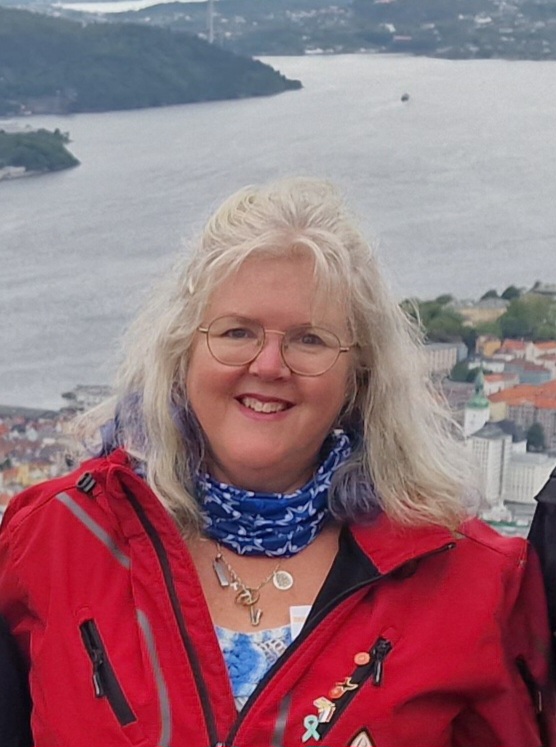
 About the Author: Anita Blom, born and raised in the Netherlands, is living in Sweden. She worked as an operation manager for the Workers’ Educational Association. She has been a board member, incl chairperson, of stuttering organisations on local, national, European and international level, and an advisory board member of several international stuttering organisations. She was a national and international keynote speaker on stuttering, had her own stuttering consultant company, was one of the Stutter Social hosts, was a project leader of several stuttering projects, and twice Member of the Year. She is an award-winning stuttering activist, acknowledged by Voice Unearthed on the Wall Of Inspiration, Stamma, and many others, nationally and internationally. She was also a leader of national and international camps for children and for young adults who stutter for 30 years. Anita, aka Scatsis, has stuttered since she was 9 and had a troublesome youth because of her stuttering. She went from being silent, to giving stuttering a voice, from pre-school children to the European Parliament, now inspiring people who stutter of all ages, they can make a difference. Do check out her previous papers to the ISAD online conferences. Due to health issues she now has to take it slow, but is still an inspiration to many, especially young people who stutter and those with ME/cfs. Her device, that’s now been used all over the world is “Sure I stutter. What are you good at?”. |
Some words arrive in silver
soft as rain against a pane,
a shimmer at the threshold,
then a sudden, shining name.
Some flare red at the edges,
strike a match against the air;
the mouth holds light a moment,
then releases what was there.
Some are blue, a held-back ocean,
deep with sentences below;
not empty, never absent –
only gathering their flow.
Some flicker gold in quick repeats,
some stretch green, leaf by leaf;
some bloom bright in company,
some darken under grief.
But no shade makes a voice less true,
no pause erases sound;
each color bears a whole self
when patient ears are found.
So let the spectrum speak itself
in tremor, wave, or choice:
the world is wider, warmer,
for every shade of voice.

Welcome to my poem. Let me know in the comments how it resonates with you.
Also have a look at my paper and leave a comment. Great to have you here! 🙂
I loved this poem, the metaphors of different types of stuttering are so vivid. I really like the nature description too; it reminds me that stuttering is natural!
Thanks for your kind words, Allie. Yes stuttering is natural. It’s how we speak. 🙂
“But no shade makes a voice less true,
no pause erases sound”
So powerful words in your poem!
Thanks so much for your kind comment, Ana Karina. Sometimes pauses give the listener time to reflect, in the day and age where talking seems to go faster for each generation.
Happy ISAD and keep talking
Dear Anita!
People who know you, know that you have such a wide range to draw from! I think your poem reaches far beyond stuttering, and embrace communication in life itself!
Thank you so much for sharing it!
Best wishes from Hilda
Tack kära Hilda. Yes, communication has so many colors in even more shades. And don’t we all love a rainbow? 😉
Happy ISAD and keep them talking
I really loved how this poem used colors to represent different ways of communicating. My favorite part was “no shade makes a voice less true, no pause erases sound.” It reminded me that everyone deserves to feel heard and confident in their voice, regardless of how fluent their speech is.
Thanks for your kinds words. And you’re so spot on. We have so much wonderful things to say, if people would only take a few extra seconds to listen. I’d rather stutter or clutter on words that make sense, than ramble fluently while having nothing to say.
Happy ISAD and keep them talking
Hi Anita! I was really moved by your poem and loved reading it 🙂 I thought the colors and imagery you used were such a creative way to describe people’s experiences and individuality in their voices. Thank you!
Thank you for your kinds words, Karen. With today’s “perfect” AI voices, I’d rather listen to heartfelt stuttered or cluttered speech. 🙂
Happy ISAD and keep them talking
Hello Anita! Your take on the way you stutter is so interesting to me. The way you use metaphors to describe how you stutter. You mentioned that stuttering does not make the meaning of what someone has to say less true. I was wondering if you ever find that others who stutter do not see it the same way or have not come to a point where they have adopted this mindset. I think it is a fabulous mindset to have and has the potential to work in such positive ways by uplifting those who stutter and reminding them that their voice is just as important as everyone else’s.
Thanks for your kind comments, Ashley. Stuttering is a journey. Many go from being talkative to feeling fear and shame due to other people’s reactions, and loose confidence, feeling different and not accepted or respected. But once we find our voice, we realise stuttering is something we happen to do, but not who we are, and that our voices matter. And as it’s hard for us to talk, what we say it worth repeating 😉 as we choose our words and choose who are worth the effort of talking. So if a person who stutters talks to you, just have a little patience, as this person thinks you’re worth the effort. <3
Happy ISAD and keep (them) talking
Great and beautiful poem! So harmonious, so paradoxical, I wish it was mine.
Haha, your words are as colorful as mine, Pedro. So happy you joined this year.
Keep talking, my friend
Hi Anita! I loved reading your poem, especially the lines “But no shade makes a voice less true, no pause erases sound; each color bears a whole self when patient ears are found.” This truly highlights the importance of finding a safe space in a supportive community to express oneself. Thank you for sharing your voice and experiences!
Thanks for your kind words, Jillian. Yes, we can talk. People just need to listen to hear the many shades of speech. As what we say is worth repeating. 🙂
Happy ISAD and keep them talking
Hej Anita!
Tack för att du delade dina vackra ord. Jag såg att du kommer från Nederländerna och nu bor i Sverige. Jag är svensk-amerikansk och bodde i Sverige i ett år som au pair. Nu pluggar jag att vara logoped. Jag undrade om du har upplevt skillnader i synen på stamning mellan Sverige och Nederländerna?
(Tack för möjligheten att öva min svenska!)
Med vänliga hälsningar,
Elise
Så kul att du kan svenska, Elise! But just so that everyone can read, I’ll reply in both languages.
Vi åkte med svärföräldrarna till USA för att hitta deras rötter och familjemedlemmar. En fantastisk resa! Ansök till programmet “The Great Swedish Adventure”, så kanske du kan hitta din familj här. 🙂
I was young when I stuttered in the NL, and in my 20+ and still today I still stutter in Sweden. So it’s not easy to compare. I never heard about the Dutch stuttering organisation Demosthenes until I was living in Sweden, and at that time it was hard to get acceptance, at least in my case. Bullying, even by teachers who simply told me to stop stuttering if I wanted the bullying to stop, hearing I shouldn’t study as I wouldn’t get anywhere anyway and getting low grades for oral exams, etc. And guess what: I’ve worked as a teacher, teaching teachers. 😉 I don’t know how the situation was in Sweden at that time.
Today I find that the situation for PWS is quite similar in the NL and in Sweden. The shift from therapy only being about fluency into therapy meaning helping you to talk how you want to talk, whether that’s with or without techniques. Awareness has also helped in both countries to make the listener understand they just need to wait a little longer and be mindful of “good advice” that can harm more than actually help. And both countries have @£$€ who’ll never get it. 😉
So we’re getting there. One step, one country at a time. 🙂
Keep them talking and happy ISAD
Thank you all for reading my poem. If you want to use it, just let me know and use my name in the credits. I hope to see you here again next year.
Keep talking
Anita