
 About the Author: Dr Jonathon Linklater is Development Director for the Irish Stammering Association (ISA), a speech and language therapist in Ireland, and stutters himself. He established an intensive therapy program called the Dublin Adult Stuttering (DAS) course in 2005. He has been working in private practice since 2011. He has been involved with the Irish Stammering Association since 2003 and has led on a number of support and outreach projects for the organisation. Since completing the European Clinical Specialism in Fluency Disorders in 2009, Jonathon completed his PhD at the University of Limerick, with guidance from Trinity College Dublin’s School of Clinical Speech and Language Studies. Jonathon contributed two chapters to Trudy Stewart’s Stammering Resources for Adults and Teenagers book in 2020. He is past chair of the Irish Association of Speech and Language Therapists; the professional body for Speech and Language Therapists. He likes to make the occasional film.
|
ISAYiT! has been the youth programme of Irish Stammering Association (ISA) since 2009. We began with a range of supports such as drama groups and summer camps. In 2021 we introduced online games clubs (Minecraft and Roblox groups). Our groups have aimed to create a supportive space for young people who stutter to be themselves without fear or judgement; instead, reducing isolation and increasing understanding and acceptance.
ISA has a mission to make stuttering more audible and visible in Irish society by way of media outreach as well as our Bród Stadaireachta (Stammering Pride) group. We regularly host our own radio show on Irish radio station Phoenix FM where stuttering voices can be heard across the airwaves (and online – listen here!). Artivism has been a more recent branch of our outreach and advocacy efforts. One of our funders for the camp is National Youth Council of Ireland (NYCI) and their support has given extra reach and confidence to explore these areas. Financial support to run the camp and general ISA activities comes from the Government of Ireland.
An ethos of the summer camp has been ‘Dligid édteanga aimsir’ – an old Irish Brehon law that gave legal protection and entitlement for people with speech difficulties – it means ‘wordlessness is entitled to time’. Stuttering is normalised in this setting, it’s what we do. In the ISAYiT! space, stuttering becomes a more positive identity, something to be shared, something to be ok with and perhaps even celebrated. Creativity can be a personal thing that people find hard to share – so this space was intended to be supportive. Try things out, see what happens… “You can’t be wrong in this room” as Charlie Hughes, one of our drama tutors, would often say.
This year we wanted to expand on our exploration of the visual representation of stuttering. We had seen the inspiring work of two artists, one Canadian and one Irish, and invited them to work with our young people.
Daniele Rossi of Franky Banky fame delivered a thoughtful and interactive graffiti writing workshop. We had seen the stop motion film work of Siún O’Connor and found this to be curiously connected to our speech. It made us think about the ‘stop start’ relationship of this art form and how stuttering can sound very ‘stop start’ for many people.
Daniele and Siún introduced their art forms and creative concepts to the young people. We spoke about how stuttering can affect people in everyday lives and discussed what we thought a wider audience may not understand. What are the challenges of stuttering? What are the messages that we want people to know?
Our young artists showed no hesitation in getting started and went to work; their creations show clarity and simplicity in their messaging, with beautifully framed and designed short films.
We went deeper on the technical and philosophical side. How many frames per second (fps) do we need for these films? How does that speed relate to your stuttering or to other people’s stuttering? Is your stuttering fast or slow or do you stutter at different rates? Does it stop/start like these images? Is your stuttering loud or quiet? How can the text and graphic bring the sounds, shapes and feelings to the page? What do you want to say with the piece you are creating? There is beauty in diversity and the variance of stuttering – how could we reflect this? Building on ISAYiT!’s work to date, it is interesting to come from this neuroaffirmative angle with young people, rather than a correctional model – and to see what develops out of this.
Our messaging was carefully curated by our young people with these themes and analogies:
1.“Don’t Break the Lights” created and narrated by Lucy & Jess.
The cars and traffic lights analogy asks for listeners to wait and go with the flow of conversation of both speakers.
2. “I did it!” created by Elayna and “Too Late Now!” created and narrated by Nicholas.
These analogies illustrate the feelings when we get out of our comfort zone to try new things and have new experiences. This can be scary, courageous and exhilarating.
3. “Coffee or Ice-cream” created and narrated by Niamh & Sam.
This piece shows the internal struggle between choosing to say what we want to say and stuttering or choosing words that feel easier to say or will be less likely to stutter on.
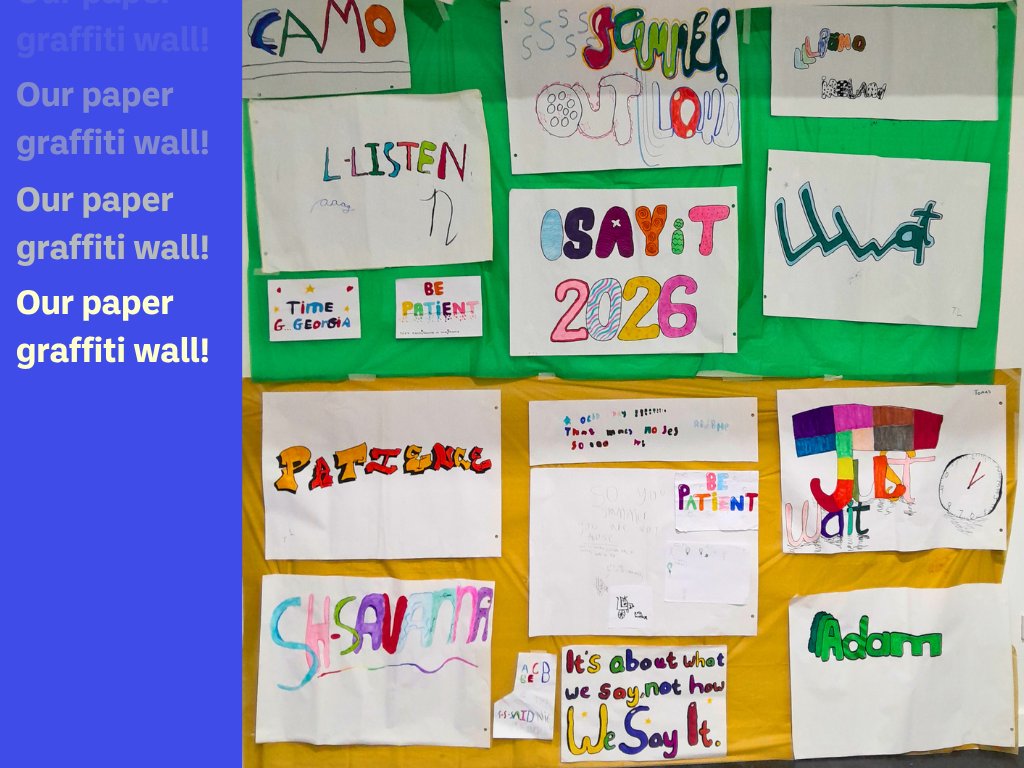
Our paper graffiti wall was loudly proud and unapologetic – this is what creativity and stuttering looks like when we play around with it! Recurring messages included wait, listen, and be patient whilst many enjoyed playing with ways to illustrate stammering with their names.
ISA’s adventures into artivism are giving us as directors plenty of scope for future planning. It is evident that youth arts and creative arts are fun and allow us to express ourselves ‘Beyond Words’ (the name of this NYCI funded creative arts project). Our youth group told us that the creative art activities allowed them to express their feelings, share their experiences and their challenges which ultimately meant they felt less alone.
During the project, it was interesting to see where the young people went with their ideas. We facilitated solutions and creativity rather than directing in a structured manner. This mirrors the shades of stuttering theme. The same colour can become many different shades; our group were given the same artistic medium and theme but they all went in different directions.
We hope that these pieces resonate with you and that you might feel encouraged to have a go at creating your own art that reflects, or draws from, your stuttering. Perhaps there is a message you’d like to give through artivism?
We also hope that these messages will resonate with wider society. Stuttering is entitled to time but also space – making it more visible, present and part of everyday life.
References:
Leahy MM. Changing perspectives for practice in stuttering: echoes from a Celtic past, when wordlessness was entitled to time. Am J Speech Lang Pathol. 2005 Nov;14(4):274-83. doi: 10.1044/1058-0360(2005/027). PMID: 16396611.
Irish Stammering Association hosting a show on Phoenix FM link for ISAD 2024 – https://www.mixcloud.com/925PhoenixFM/irish-stammering-association-22-10-24/
Stop Motion Studio app was used to create the short movies
Artists:
Daniele Rossi: www.frankybanky.com
Siún O’Connor www.siunoconnor.com

Thanks again for inviting me to teach the kids how to write/draw graffiti! The kids showed so much creativity and their artwork was beautiful. Just the stop motion animations. The latter makes me want to give stop motion a try. I’ve also been watching a lot of classic Paddington 🙂
The stop motion animations are fantastic aren’t they? The workshops you run with ISA are amazing and help our young community explore different creative ways to express themselves! I think a stop motion Franky Banky and Ti-Ger would be roarrrsome!
There is so much we can express about our stuttering through art, and sometimes that is the best way to convey what our words cannot. Thank you for the article!
Alexandra, from Bolivia!
Thank you for such a lovely message. We called our project Beyond Words because there is much more our young people want to express … and creative activities help do that! There’s a lot they want to say and we agree with you, art can convey what words cannot!
This artivism is amazing, and I love seeing how each participant took their project in unique directions! Art truly is another language, especially for younger individuals, for communicating their ideas. I was wondering if you see their confidence/view of their stutter alter throughout these projects? I can imagine that reflection through art, and viewing one another’s projects, can often have that positive effect. Thank you for sharing!
Thank you for your lovely message and feedback! Yes, we find the art has a positive effect… in different ways. Some young people are hearing other children stammer and talk about stammering for the first time. It gives them confidence to talk about it themselves. Other members of our group use art to talk about stammering and express feelings/messages which is very inspiring. Our young adult youth mentors are a huge asset to our community as they give support and encouragement to our younger members whilst also being vulnerable in sharing their own experiences with them. We also hope the art reaches members of the stammering community who don’t come to our workshops but still get some benefit and see their stammering in a different, more positive, way.
Thank you for sharing these beautiful messages from youth who stutter, Jonathon and Penny. What a wonderful program you’ve created!
Thank you so much! We are very proud of our young community and love the relationships we have built with artists. We can’t wait to see what new ideas and artivism they create in future, but it’s lovely to have these “permanent” art pieces to look at and share.
I loved the stop-motion videos, particularly the one titled “I did it!” It did such a great job illustrating the mental back-and-forth and battle of people who stutter when anticipating their stutter in a stressful situation such as ordering at a restaurant. Each video was so unique and informative. Great job everyone!
Thank you so much, they will be delighted to hear your feedback! We also loved how they conveyed this type of scenario. We loved that they showed the “win” was saying what they wanted to say and ordering the food they wanted.
Thank you both for all you do for kids who stammer! You not only make them feel valued and their voices listened to, you make stammering FUN and help them find their own voices. I wish I had you when I was a child. But maybe not. As I wouldn’t stop talking. 😉
Keep them talking!
Anita
We would love for you to keep talking! That’s our goal at the heart of what we do – for our young community to feel that they belong, their voice matters and they can have fun with exploring their stammer and their feelings about it! Thank you and the ISAD team for your time and work to bring the online conference together each year so that we can learn and share with each other from all corners of the world!
Thank for creating a safe and confident space for children to espress themselves. This was a great article and videos to view, uplifting the voices of children creates an early sense of belonging that is vital to development. Through creativity, we can create a foundation of support!
Thank you so much for your lovely comment! We also feel that developing a sense of belonging and a safe space to explore stammering is so valuable for our youth community. We want them to have fun but they also have an opportunity to share the challenges they experience so that they do not feel isolated in either their identity or their experiences. We also hope the videos can reach young people who haven’t had an opportunity to meet other young people who stammer “in real life” so they also feel part of the community and reduce their feelings of isolation in knowing that other young people “get it”.