
|
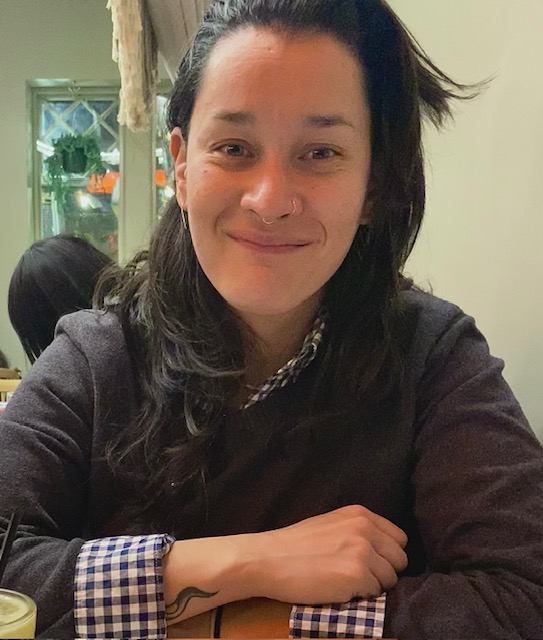
My name is K. Smith (they/them) and was born in Boston (Dorchester), but now I live in Somerville, MA. I am 34 years old and I have stuttered since the age of four. I am currently a Masters’ of Public Health candidate at Boston University with a concentration in Health Equity. I am very interested in researching the intersection of drug use and people who stutter, and most importantly, how society views stuttering through a public health lens. I recently transitioned to a public health career in 2022. Before my transition, I worked in restaurants for 8 years as a line cook and then a chef. In an effort to begin my healing journey from internalized stigma due to stuttering, along with severe anxiety and depression, I needed a change. Last year, I began attending a support group for adults who stutter at Boston University. It changed my life. |
For Patrice Kelly & Alec Canarri: may you both rest in eternal peace.
For 8 years, I was used to the clinking and clanging of pots on stove-tops, menu orders being recited like melodies, and the cultish response “yes chef”, or “heard”. For 12 years, I craved the camaraderie, love, acceptance, and debauchery of the misfit groups I typically found myself in. Despite being surrounded and supported by people who cared for me deeply, I could never escape the isolation of being the only person who stuttered in every setting I existed in.
Before drugs and alcohol, there was playing in the backyard with my neighbors, there were teammates, there was laughter, and there was an innate sense of knowing my intelligence. My confidence couldn’t be quantified, and it knew no bounds even during speech therapy. Patrice Kelly, my speech therapist, would always rest her hand on my shoulder while we waited for my mom to pick me up from the Tynan School in South Boston.
I was discharged from speech therapy at the age of ten or eleven. My world was about to get much bigger, having been accepted to the top exam school in Boston. I was 1 of close to 300 students in my class. Patrice must have known I was ready to leave her and thrive in whatever setting I found myself in, because I was ready.
However, it was exactly the opposite. I didn’t know how invasive isolation was, and how it would continue to poke holes in the plans she and my mother had for me.
I made it through high school as a covert stutterer. Close friends knew I stuttered, and that was without me telling them. I would stand up and give oral presentations with less nervousness then, and maybe it was because I felt free, and young, and had a lot of friends. As is tradition, senior yearbooks require banal superlative categories that celebrated your classmates’ achievements. The yearbook editor came up to me, also my good friend at the time, and said, “Kay, you received the top votes in three categories: most athletic, most popular, and the class clown. Which one do you want?”
Class clown. I made it through high school.
My world got bigger in college, the pressure more immense. I was balancing academics, a sport, work study, and interpersonal relationships. This balancing act was nothing new, and I couldn’t help but notice that more was at stake. Worst of all, I couldn’t find or achieve a single moment of fluency. My ability to balance my responsibilities, at best, was mediocre. And finally, two people laughed at me because I stuttered during a presentation I gave. My world came crumbling down because of how egregious it felt.
In that same class, I noticed someone glare over at the two people who laughed at me. I didn’t know him, but at that moment, he was my knight in shining armor. And soon after, he became my best friend and often facilitated those frequent moments where I was able to escape from my everyday reality of being the only person I knew who stuttered.
When I was high, I felt at peace in those quiet moments alone. When I was high, I felt at peace in a group of people. I wasn’t analyzing every single word that came out of my mouth, I wasn’t thinking about what word I was going to say next and whether it would come out, and I wasn’t worrying about who was going to judge me. When I was with Alec, my knight in shining armor, fluency was never a requirement.
Fluency was a requirement for me at every other moment of my life. It was a rigid standard I set for myself, it was a contract. Presentations in college were inevitable; I couldn’t escape them. I couldn’t escape the work it took to prepare for them. I either prepared, or I didn’t prepare, and I would hope for the best. Often, my best would not be my best, and the shame I would feel afterwards triggered an endless berating thought-loop of negativity. I cried for the first time about my stutter in college to a therapist, and during my last presentation.
And finally, I graduated. I made it through college with the addition of an extra semester.
Restaurants felt like a 10-hour basketball game with time-outs, moments to be in full-sprint, and a post-game stretch. Communication was key, it was constant, and you simply couldn’t do the job without talking. After graduating college, I found myself as a hostess and bussing tables when the chef asked me if I wanted to try working in the kitchen. “Of course”, I said.
I excelled. I was fast, I was organized, I was fun, I did my job better than the guys, and I got extremely used to post shift drinks that never ended. My cup was always half full. I was in wonderful company with people who were able to use substances during their shift and after their shift. Still unable to achieve fluency when I wanted, my frustrations were temporarily alleviated after my first hit or my first drink. “I’m fine”, I would say.
Eventually, I moved to Oakland and worked in San Francisco to work for one of the best restaurants in the city. Invincibility was a shield for only so long. I was able to flex my muscles and my skill, until I had to present my new dish in front of all the staff during pre-meal. I didn’t know I was supposed to do this. I thought to myself, “Why didn’t anyone tell me this was going to happen?” I tried to leave, Joyce, my chef, grabbed me by the arm. I knew what this meant.
“My dish consists of f-f-f-f-f-fri-i-i-i-e-d o-y-y-y-sters…”
When it was over, my good friend Tony put his hand on my shoulder, not the way that Patrice did. And I walked out.
Weeks afterwards, I was sitting in my sister’s apartment in San Francisco when I asked to borrow her computer. I typed into Google “jobs that people who stutter can have”. As expected, I found nothing useful. I gave my sister her computer and left, when I received a text from her. She said that it made her sad that I didn’t see how smart I was, or how strong and talented I was. It didn’t matter. I couldn’t speak in front of crowds – how was I ever going to do anything as a leader?
Strong friendships turned into a motley crew who spent at least four nights out of the week drinking at Vesuvio Cafe in North Beach after work until the early hours of the morning. And in that year alone, my cousin, my Oma, and my good friend from college all died. I couldn’t possibly address my mental health the way I should have, so I returned home.
I spent the next three years working at a pasta shop as a manager, on the front lines of providing customer service to shoppers. I worked at the register, took sandwich orders over the phone, created menu items, and spent so much time talking. My brain was never quiet. And even though I was in regular therapy again, the first time returning since I cried to my therapist in college, it was like a haunted carousel that never stopped, and on the carousel were my memories of disfluency and poor thought patterns. On the haunted carousel was a memory Alec, who overdosed and died. I never felt so alone.
Loneliness forced me to seek something different.
The 10-year-old sitting with Patrice, ready to face whatever came to them, urged me to find another career. My interests in social revolution, equity, and structural racism were peaking, which didn’t seem to align with who I was in my current role in the food industry. I applied to work as a Community Health Worker specializing in food access at a health center in the city where I grew up in. It meant that I needed to interview over Zoom, and I told them that I stuttered without even knowing about disclosure. I got the job.
I began thinking about getting a master’s degree more critically. Still, the negative thought-loop told me I couldn’t if I wasn’t comfortable speaking in front of large groups or giving presentations. I thought that switching careers and moving away from environments where drugs and alcohol were ever-present, my stutter would get better. It didn’t.
Weeks later, desperate for an answer, I typed into Google “free speech therapy Boston”. The Center for Speech Therapy at Boston University popped up. I couldn’t believe it. I completed the intake form, with the understanding that I may not hear back from them because there was a waitlist. In January of 2024, I spoke to a friendly voice and spoke about my potential goals, which for me was ultimately stronger communication. The friendly voice would let me know when space opened for free speech therapy.
In the meantime, I found a speech therapist that accepted my insurance. Because she wasn’t within my network, I had to pay $75.00 per session for 30 minutes. She recommended I see her weekly. I simply couldn’t afford it, and after three sessions, I ended our sessions abruptly.
A few months later, that friendly person emailed me, and asked to coordinate a time to talk about free speech therapy at BU in the fall.
September 2024, almost one full year ago, my life changed for the better. That friendly voice and I met, along with a student clinician who would help me identify my goals for accepting my stutter and living as I am, a person with a stutter. This goal setting pushed me to challenge myself and my thinking of my capabilities. And finally, Caroline Brinkert, with that friendly voice, invited me to attend a well-established group of adults who stutter, which has existed for 20+ years at Boston University.
Attending this group was the missing link to feeling fulfilled in my life. I no longer feel lonely but empowered. I had the privilege of being in a room with fifteen or more people who stuttered at a time – all their blocks, repetitions, and voices just as beautiful as the next. I have made friends and longstanding connections that provide me with the strength to speak day by day, fluently or not. I have learned so much about the experiences of other individuals who stutter and carry their pain as if it were my own. Their unique perspectives have driven me to formulate the impact I want to have in this world.
I was accepted to graduate school, and I am now in pursuit of my Master’s in Public Health with a concentration in Health Equity at Boston University. I’m eager to use my perspective as a person who stutters to help positively shape stuttering from the public health perspective to bring more awareness to it within the workplace, health care, and beyond. Our voice is our tool to advocate, regardless of how it sounds. I’m no longer feeling powerless but uplifted in a way I could have never imagined.
I’ve listened to Michael Kidd-Gilchrest speak at a conference he led at Boston University, and have messaged with author John Hendrickson, thanking him for his book. This summer, I took the opportunity to connect with several organizations advocating for stuttering awareness, stuttering acceptance, and representation in modern day media.
Recovery from the negative feelings I’ve felt towards myself because of my stuttering is my lifelong practice. I think that those involved in this community are on the cusp of something transformative that can go beyond its expectations, breaking down barriers along the way.

Thank you for sharing, K.! You’re a great writer- the stories you’ve shared are so personal and vivid. Definitely relate to your idea of fluency feeling like a ‘rigid standard’ you set for yourself. Very cool to hear the impact that attending a support group and connecting with others who stutter has had on you- this is something I’ve just started exploring myself recently so it’s fantastic to hear from others who have done the same!
Hi Finnian!
Thanks for the lovely comments. I encourage support groups, through and through. I’m lucky to be a part of the Boston University community that has had an outstanding program for 30+ years. Best of luck on your journey.
Thanks for the heartfelt sharing <3 After the hard times of losing your love ones, glad that you can study and work on advocacy (your true passion), even your profound experience and achievement as chef should still inspire you in other ways.
I feel the same about an adult support group being the missing link. I am running such a group voluntarily in Hong Kong, even though it is much smaller than yours in Boston, I believe it still means something for some of us.
Good afternoon!
Greetings from Boston. I’m remarkably impressed with your efforts to run a stuttering support group in Hong Kong. In the Boston University group, we had a few members from China that were in graduate programs at Boston University. I loved listening to their perspectives. Thanks for your kind comments.