
 About the Author: About the Author:
Andrew Longo is a person who stutters, a senior at UNC, and an amateur lego artist. He began to stutter as a teenager and is today studying to become a speech-language pathologist. He loves meeting new people who stutter and listening to and learning from their unique stories. |
I began to stutter in a time of change, when I moved from middle to high school. At this moment, already so full of chaos, I stepped forward and suddenly couldn’t find my footing. When I stuttered, I felt as if I was rock climbing in the pitch black, reaching above my head for where the next handhold should be, only to find nothing there. I would flail around searching everywhere as the panic built in my chest, stuck there. The stability should have been there, but it wasn’t.
I felt a constant, self-inflicted pressure to speak without stuttering. My attempts to hide my stutter through ‘coolness’ made me unkind, which isolated me from my lifelong friends. At the time, my one source of joy at school was theater. I have always loved stories, and theatre projected me into the worlds that captivated me. However, even this one refuge was threatened by my attitude towards stuttering. During my freshman year, our theatre group performed three plays. For each and every one of them, I would ensure that I was cast into a small role with only a handful of lines. Then, about two weeks before the performance, I would summarily inform my teacher that I would be unable to attend due to “family complications.” My theatre teacher, a joyful soul with purple hair as vibrant as her personality, would go so far as to offer to move the performance date, but I remained inflexible. However, I began to feel regret seep through the armor I had forged when my deceit was met with such compassion.
In my sophomore year, she informed us that we would be performing a play called The Outsiders. My planned approach would be the same: pick a low-level character at random, audition for the role, practice for about a month, and then find a reason to bail out with enough time for me to be replaced.
I chose a character named ‘Sodapop Curtis,’ because that sounded like a comedic character who would crack a few punchlines and deliver some levity to an otherwise quite somber story. At this point, I had immense anxiety over my desire for others to see me as a comedian, as humor (mistakenly) appeared to be the main currency of popularity. The role seemed perfect; I would prove I was funny to my peers but not actually have to perform. But this time was different. Sodapop was a kind, thoughtfully goofy, and conscientious big brother. It was said of him that he “got drunk just on plain living.” To fifteen-year-old me, this was the personality whom everyone at my school had known me to be, who I wanted to be for my brothers, and who I had, at the time, failed to be so dramatically. At that moment, I saw a path open up to me to redeem myself for all the mistakes I had made over the past two years, and this character became the angel on my shoulder going forward.
I wanted this role more than anything, and I can still remember the feeling of sweaty, fidgeting apprehension when the day of the audition came. As luck would have it, the audition turned out to be a mild affair. Apparently, I was the right height in relation to the other ‘deuteragonists’, and I was cast into the role. ‘Deuteragonist’ just means secondary character. However, so proud of my part, I would flaunt my “deuteragonist” status to anyone interested (and plenty who weren’t). Now, I naively thought, it would be an easy climb up the mountain of fame and popularity.
The first line-reading practice was a catastrophe. My first line was “It’s ok.” That “i” sound was a particular struggle for me, and after a second or two of awkward silence, I blurted out “ss ok,” and hoped it would be ok now that I was settled. What followed was a small monologue that began with the name “Darry”. This “D” sound was, at the time, my archnemesis, and I was stranded. For the first few seconds, I tried to form the shape of the letter in my mouth with nothing but scattered clicks coming off my tongue. Then, I mumbled that I just needed a sip of water, which turned into two, and then promptly into an entire bottle, as the whole troupe sat silently. I only dared look at the blank whiteboard in front of me, terrified of the judgment I thought I would see in their eyes, forgetting that these were people who had cared about me for as long as I’d had memories.
It got to a point where I said that I had to go refill my water bottle, so I got up and left, my eyes fixed on the floor in front of my feet, and spent the remaining half-hour of my theatre class waiting at the fountain, soaked in a puddle of my own self-doubt. Most concerningly of all, I knew that I had passed the point where I could come up with a clever excuse to quit the project because the real reason would be so obvious.
Months earlier, my parents had encouraged me to meet with a speech therapist, as my stutter had begun to have a noticeable effect on my self-image. However, in my immature mind, it seemed like therapy of any kind would project an image that I couldn’t take care of myself, and I rejected speech therapy. However, the summer before my sophomore year, I realized that my condition was only becoming more severe, and I begrudgingly began meeting with a speech-language pathologist named Shelby. Her office featured several potted plants and a stylized painting of trees, making this space an oasis amidst my fears. I remember the first day I met with her, she asked me directly, “What is your goal in coming here?”
“To stop stuttering,” I replied succinctly. It seemed a foolish question.
“Well, why is it that you don’t like raising your hand in class or taking part in group discussions?”
“Because my stutter stops me from doing so.” My apprehension about therapy seemed to be confirmed.
“Is it your stutter that prevents you from talking, or is it your fear of others knowing that you stutter that holds you back?” This was a thought that I had locked away deep in my heart. “You know, I stutter too,” she remarked kindly.
“That’s fantastic!” I shouted. There was hope after all. “Well, how did you stop stuttering?”
“I didn’t.” Those words sent me into a whirlwind of confusion. “I decided that what I said was worth being heard and that I would find my voice. As a byproduct, my stutter became less pronounced with time. So, what if instead of forcing yourself to stop stuttering, you made it your goal to say what you want to say, regardless of how you say it?”
Energized by this phrase, my work with Shelby quickly became focused on helping me prepare for the play. We would go through my script, circling every individual sound that I had trouble with. She found ways to make them seem like malleable tools instead of immovable objects. We would act out the scenes of the play one by one, with my mom and Shelby playing the other characters around me. The door of her office became the door of Sodapop’s, and the old landline phone was for my character’s calls. Week by week, a crucial sense of fun returned to my life.
And, slowly but surely, my confidence came back to me as well. As a result of running through my scenes over and over again, I thoroughly knew my lines and could, in turn, help others gain better control over their parts and confidence in themselves. Despite the frenzy that defined those last few days before the show, I was able to remain calm and mentally prepare myself for what was to come. This shared experience helped me reconnect with my friends, strengthening relationships that I still have to this day. However, I had no idea what to expect when I put myself before a packed theatre full of people I looked up to.
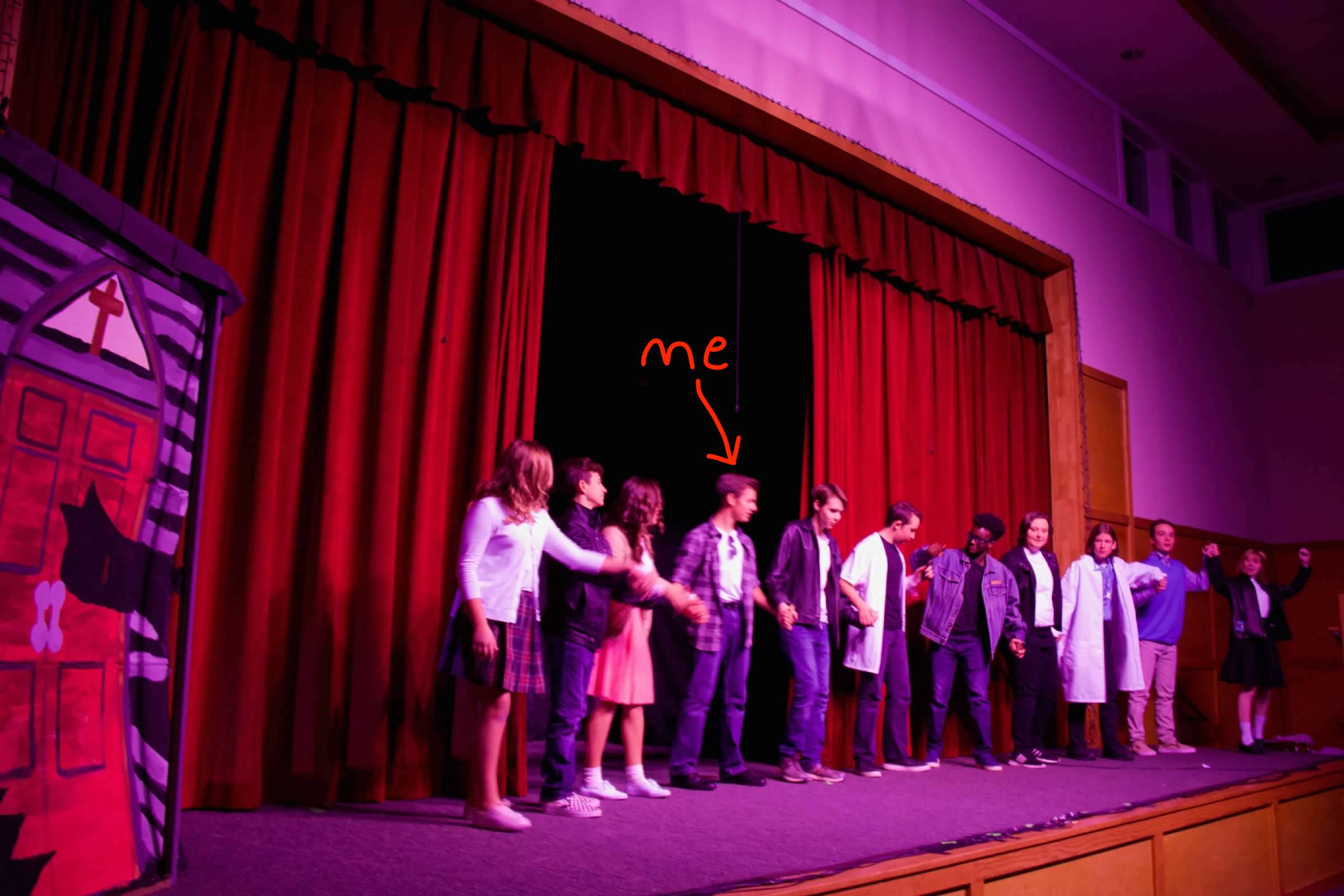
I remember with perfect detail driving to the show with my family. My dad, whom I had been terrified of disappointing through a disarticulate performance, told me genuinely that he was proud of me for having the bravery to do this, regardless of what happened, and his warmth filled me with joy. Before I knew it, I was sitting in the wings, just about to jump onto the stage and say, “It’s ok.”
I doubt that I will ever forget the feeling. I was standing at the front of the stage, with the other actors on either side of me. The stage lights were bearing down, their blinding heat and the stress of the moment causing sweat to build up on my skin. Thanks to the lights, the view in front of me had faded into darkness, and I had nowhere to easily put my eyes. I could feel the gaze of all the actors off stage, but instead of being judgmental, as I had wrongly thought they would be, they were filled with love and support. I took a deep breath and reminded myself to say what I wanted to say, regardless of how I said it, and I released all the emotions of those stressful months before this moment. I left with no regrets. I cannot remember stuttering a single time throughout that performance. This shows not that I was fluent from beginning to end, which I wasn’t, but rather that I was focused on the joy of the moment. To quote Sodapop, it was okay.
My stutter, much to the dismay of my younger self, has never left me. Despite (or perhaps because of) a stutter, I was chosen to be president of my former school’s student council by my peers, and today I exhibit my Lego art at public exhibitions, have spoken openly about my stuttering to an audience, and am pursuing a career in speech-language pathology, all of which lead me to talk to dozens of strangers. Most importantly, I am happy.
Unlike works of theatre, our lives are not often fundamentally changed by a single moment, and it would be incorrect to say that I viewed my stutter with acceptance immediately after this play. However, this episode led me to a point today from which I see stuttering not as the antagonist of my story, but as a supporting character who pushes me to become a better version of myself. In fact, I would go so far as to say that stuttering is my greatest strength.
Stuttering caused me to work more rigorously on my acting than I otherwise would have, and I thus achieved a higher level of performance than ever before. I learned that asking for help is not an admission of weakness but rather a manifestation of maturity. This experience showed me that I gained the respect of others (and most importantly myself) through having the courage to speak in front of one hundred people, whatever the outcome. I learned the quality of my friends, who never gave up on me despite my moments of anger. Stuttering illuminated the intricate world of communication and has led me to discover a future career that I never would’ve found otherwise. Most of all, stuttering has given me the empathy to understand that the challenges faced by other people are not always visible. As such, I have learned not to judge or stereotype others based on their conditions. Instead, I take the time to listen (however long it takes) in order to understand their own unique stories. Stuttering taught me that our greatest challenges do not show us who we are as fixed beings, but instead give us the opportunity to discover who we want to be.
This story is dedicated to my mom, who believed in me even when I could not believe in myself. ♥

What an amazing story! Thank you for sharing your story while being vulnerable, resilient and a role model for others. I look forward to following your story as you develop your career and touch many more lives.
Thank you for changing my life and the lives of so many others for the better. I would be nowhere near where I am today without your innovative and life-affirming approach to healthcare.
Wow, Andrew, I was drawn in from the first word. Your vivid descriptions and word choices perfectly explain what you were going through. I especially liked . . . “rock climbing in the pitch black.” That describes some feelings I have right now in my life, both pertaining to my stuttering and some other issues that are deeper and right now, more important than stuttering.
I am so glad that you did throw yourself back into the theater piece and that you allowed your friends and all the people who love (d) you to show you that both literally and figuratively.
I am so curious about Shelby. You mentioned that you are a senior at UNC, so I am guessing that maybe you also live in North Carolina. Is your Shelby possibly Shelby Potts? I met her many years ago when I visited NC and actually went on to interview Shelby (and her mom – it was that long ago) for a podcast I do exclusively for women who stutter. What a coincidence that would be if it is the same Shelby!
Keep up the amazing work Andrew. You will make a fine SLP one day, as you come with a mountain of personal experience, as well as profound insight from friends and family on how to interact with people who stutter.
I am thrilled to have read your paper. I was caught up in it, like I said, in the first few words.
Pam
Hi, Pam! I am very thankful that my story resonated with you. We are never alone. Yes! Shelby Potts turned my life around and is the greatest mentor I could ever ask for. I need to listen to your podcast! It’s incredible that you interviewed her back when she was an undergrad at App State! She has completely changed the field of stuttering, cluttering, and fluency Disorders for the best. I will have to talk with her about the podcast when I next see her. Thank you for taking the time to write this, it means a great deal to me. I am very inspired by your story and will be in touch!
Hi again Andrew,
Wow, what a wonderful coincidence. I met Shelby (and her mom) so long ago and it’s so cool that we both know her. Here is the link to her podcast episode if you want to take a listen sometime – I can’t believe how long ago it was. (2011 – goes to show you how long I’ve been podcasting and that I’m kind of an “older rockstar” now!)
https://stutterrockstar.com/2011/05/11/its-a-we-thing-episode-55/
Much success to you!
~ Pam
Thank you so much, Pam! This will be a joy to listen to. Thank you for your decades of work in empowering women who stutter. Over 270 episodes is an incredible accomplishment
Love this Andrew, a fantastically written piece! Big fan of the rock climbing analogy. I relate a lot to your experiences in terms of assuming the reactions or judgement of others (when it in reality it’s often not there), and finding stuttering to actually be a strength and something that can push us to achieve more. Great to hear your experiences and how they’ve contributed to your views on stuttering now, inspiring stuff!
Thank you, Finnian! It’s so easy for the brain to assume the worst, and so relieving when we can realize that it isn’t actually the case. I love your analogy of patience in the moment of stuttering to football. That was such a cool way to connect your passion to your life experience with stuttering.
This is an incredible story – thank you so much for sharing! You’ve done a great job expressing the emotional aspects of your experiences with stuttering. I am sure that empathy and perspectives that you gained through speech therapy and coming to view stuttering as a strength will help you be a fantastic SLP!
Thank you, Abigail! I am grateful for every step of the path that has led me here
Beautiful account of your story, Andrew! “This shows not that I was fluent from beginning to end, which I wasn’t, but rather that I was focused on the joy of the moment.” How wonderful to see you find freedom and joy in communication! – Ana Paula Mumy
Thank you, Dr. Mumy! I am very inspired by your work through Spero Stuttering in empowering people who stutter of all ages to find the freedom and joy that make communication so wonderful. I loved learning about Camp Shout Out, what an invaluable, stutter-affirming opportunity for young people!
You painted a picture through words and I felt as if I was in your shoes as the events happened. Thank you for sharing your story as it is relatable to many of my students I see as a speech-language pathologist assistant. Your story will help me guide my therapy sessions to find out more about the student and how they are feeling rather than how they stutter. You are an amazing role model for so many who may need your story to give them the perspectives you have to find the freedom and joy in communicating.
Paige, that is the most fulfilling compliment I could ever receive. Thank you for taking the time to read the story. I also love the question that you asked the panel; your focus on generalization sounds like an immensely valuable approach to speech therapy!
Andrew,
Thank you for sharing your experience! Reframing your goals from wanting “to stop stuttering” to fully participating in the moment, regardless of your fluency, was such a powerful moment. I’d like to think reading or in this case, acting in, the ‘The Outsiders’ is a formative moment for all. Good luck in your speech-language pathology pursuits!
Hi Rayma, thank you for your kind words! It is always inspiring to hear from others about similar transformative moments in their own lives. Also, what a great book! (I also have a soft spot for the ’83 Brat Pack movie)
Dear Andrew,
Wow, your story is so compelling. I would totally buy a book of yours because your story is inspiring. The moment you described standing on stage and saying “It’s ok” felt incredibly powerful and symbolic of self-acceptance. I also appreciate how you highlighted the role of empathy and perseverance in shaping who you are today. Your story is truly awesome and a reminder that what once feels like a limitation can become a defining source of purpose and growth. Thanks for sharing
-Kim
Hi Andrew,
Thank you for sharing your lovely story. It was absolutely beautiful to read about how your view on stuttering changed and how you became so confident. It is truly inspiring! I was cheering for you during your entire story. I too was incredibly touched by what Shelby said. There are times when we are our biggest critics, and forget how many people are in the stands cheering for us, and willing to listen to us no matter what silly, nonsense, amazing, thing we have to say. Those are the people that make our lives beautiful because they are willing to be there to listen to us, no matter what. Congratulations on completing your play, finding your strength and a career you love. I wish you continued success and happiness always!
-Maria
I can really relate to this because I used to be a music major, and I often felt more comfortable on stage than in everyday conversations. Performing gave me a sense of control and confidence that I didn’t always have when speaking with others. How can learning to accept something we once feared or struggled with, like stuttering, change the way we approach challenges in other areas of our lives?