
 About the Author: About the Author:
Catherine Chan is the chair of the Hong Kong Stuttering Support Group. She is a Christian who plays a supporting role related to emerging technologies in tertiary education. Her recent areas of interest include counselling, disability art, expressive art therapy, and she is passionate about promoting inclusiveness through stuttering advocacy. Catherine’s hobbies include museums, visual art, wildlife, jazz music, and Postcrossing, among others. |
If a stutter were a cassette tape
At rest, it
looks perfectly normal
Side A
Press the play button
The cassette player smoothly sings your favorite song
As everyone expects
Until it reaches a particular word
It gets stuck
You quickly press the rewind button
Like when you hit a wrong note while practicing piano and want to start over
The insistence on playing it flawlessly in one go
Again, precisely, gets stuck at the same word, accompanied by strange noises
The audience’s bewilderment
That lyrics line keeps replaying in your mind
You don’t have Hawking’s speech synthesizer
So you press the stop button
Pull…out the tangled tape
Brutally brings this struggle to an end
Side B
Press the play button
5:59 PM, walking into a Cha Chaan Teng, the waiter asks,
Anything to eat?
I press the fast-forward button
The cassette player slowly spits out:
Sa ssa saa, sssa, salad, (please.)
Relating to 2025 ISAD’s theme:
A cassette tape has two sides, much like how we can perceive our stutters from different perspectives. On one side, it causes difficulties in communication —making speech challenging and interfering with listeners. On the other side, stuttering is one of the traits that differentiate us from the “normal” majority. I don’t take things for granted, as speaking fluently may be easy for some, but others might struggle greatly. In such moments, patience and compassion are what we need most.
In Chinese, the words for “question” and “problem” (問題) are the same. Once, I was stereotyped as a “problem kid” in a collectivist Asian society that emphasized obedience, for not fitting in and questioning almost everything. Now in the era of AI (artificial intelligence), being able to ask good questions has become a treasured strength. Similarly, in the pursuit of uniqueness in art and literature, my deep reflection as a person with stuttering (PWS) serves as a source of inspiration. While authoritative medical discourse may depict stuttering as an issue that requires correction, members of the stuttering community can express our diverse experiences in creative ways that may challenge and change public perceptions.
As a nostalgic child born in the 1990s, cassette tape was a fond childhood memory of mine, and I am surprised to see them becoming popular again among Gen Z. In colloquial English, the lagging sounds on old cassette tapes are often referred to as “stuttering”. Although cassette tapes are inconvenient and sometimes unpredictable, I still treasure the “I’m-perfect” music listening experience they provided, which can be seen as a further analogy to our stutters.
More about the poem:
Before the age of smartphones, cassette players and recorders were affordable devices for students. Back then, my Cantonese opera teacher and speech therapist assigned me to record and listen to my own singing and speech for practice. I enjoyed singing in falsetto (a high-pitched female voice) without stuttering. However, I hated listening to my own voice — until later I realised it could be a crucial step towards self-acceptance.
The frustration in piano practicing was my personal experience as well. I was irritated when my mom ordered me to say the same sentence until it was 100% fluent. In learning classical music, I doubted whether my failure in the diploma exam was due to a merely nervousness, lack of talent, skills, or perseverance. Similar to public speaking, there were occasions when I practiced extensively before going on stage, yet still failed to control my muscles. Methods and mentality matter — only then can our efforts truly pay off.
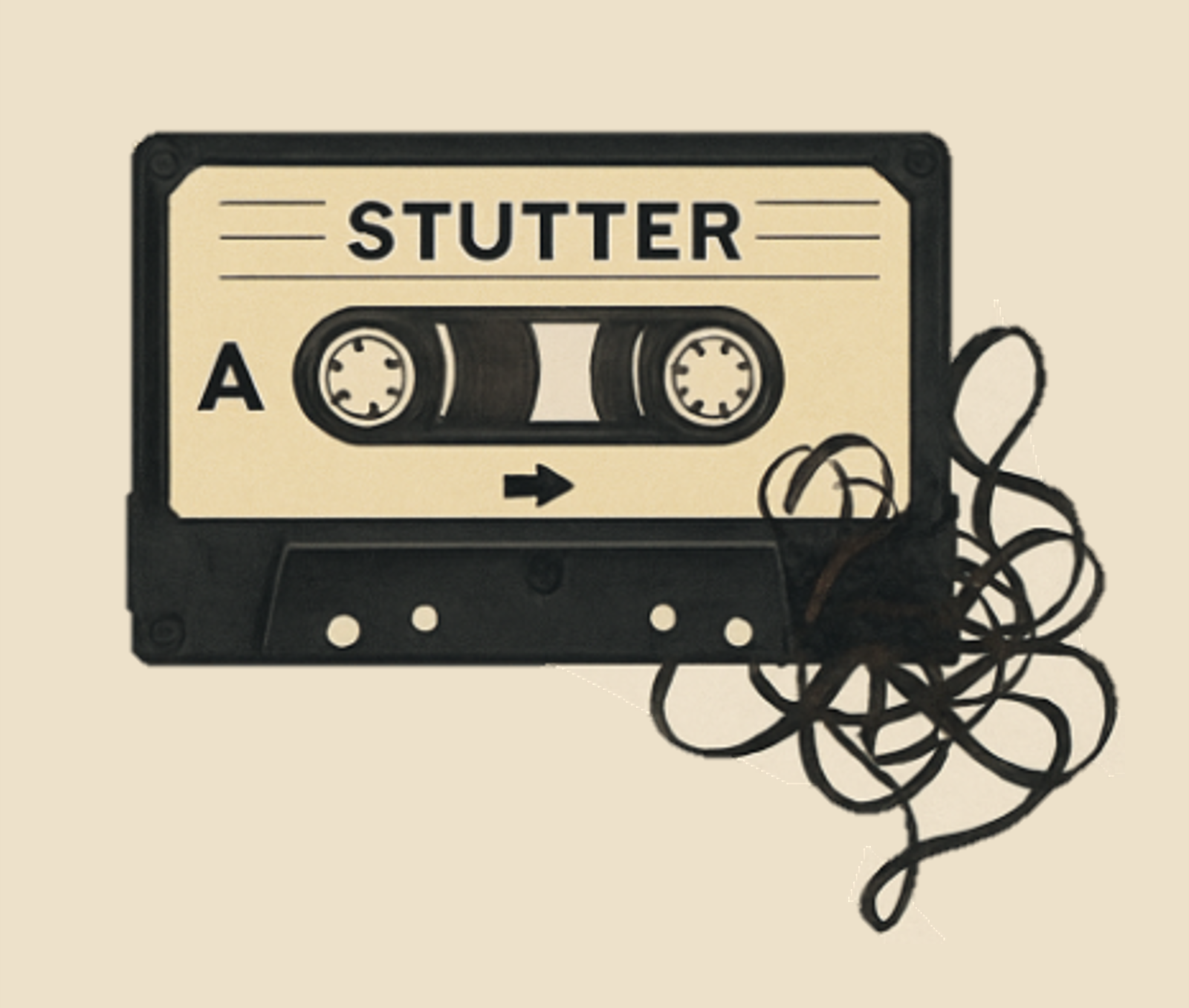
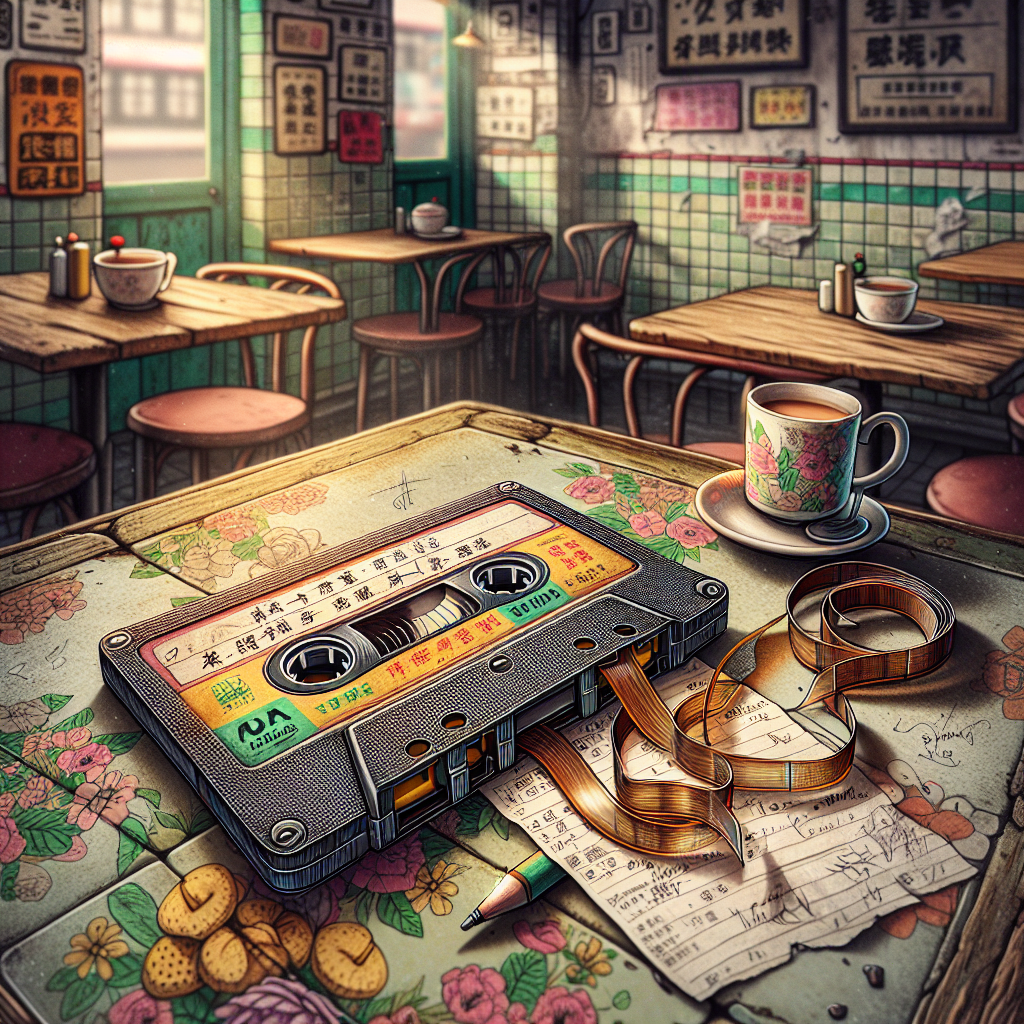
This poem is originally written in Chinese for a novice poetry class. The two illustrations used for the English and Chinese versions are generated by AI models DALL·E 3 and GPT-Image-1, respectively, which give different cultural touches to my text. On Side B, the reference of Cha Chaan Teng may require explanations for foreign readers. It is a common type of restaurants in Hong Kong, known for its speedy service and fusion cuisine. Some Cha Chaan Tengs offer an afternoon tea menu from around 3pm to 6pm. During peak hours, some waiter or waitress may be rude to customers (including tourists) who cannot place their orders quickly. Fortunately or unfortunately, nowadays more and more of these local restaurants use QR code to replace verbal ordering in order to save labor cost.
Original Chinese version:
卡式錄音帶
假如口吃是一餅卡式錄音帶
靜止時,它
看起來一切正常
Side A
按下播放按鈕
卡帶機流暢地唱出你的首本名曲
按照眾人的期待
直至唱到某一個字
卡卡住了
你趕快按下倒播按鈕
像練琴彈錯音時總想重頭開始
要完整無誤彈好一遍的堅持
再一次 精準地 卡在那個字 並夾雜奇怪聲響
觀眾的困惑
那句歌詞在你腦海中不斷回放
你沒有霍金的說話機器
只好按下停止按鈕
把糾纏不清的磁帶拉……出
強行終結這場搏鬥
Side B
按下播放按鈕
5:59pm走進茶餐廳,侍應問道:
食咩?
我按下快播按鈕
卡帶機徐徐吐出:
沙沙沙 沙沙 沙律(唔該。)

Hello Catherine, so interesting to read and reflect on your poem. Thank you for writing and publishing it. I know publishing personal creative work can be very intimidating, so a big thank you for putting yourself out there.
Your poem made me think of a Brian Eno quote that I’ll put below, but the quote is about how the things in technology that we once look at as failures, eventually become their signature, the thing we love most about them. And it made me reflect on the double-edged sword of stuttering. On the one hand, the disfluency in the moment must be frustrating, but on the other hand, when you speak it means your voice is unmistakably yours. Nobody will speak exactly like you do, your voice a perfect snowflake, unique compared to everyone else’s. Thanks again for publishing!
Warm Regards,
The Narwahl.
PS: This is the Brian Eno quote:
“Whatever you now find weird, ugly, uncomfortable and nasty about a new medium will surely become its signature. CD distortion, the jitteriness of digital video, the crap sound of 8-bit – all of these will be cherished and emulated as soon as they can be avoided. It’s the sound of failure: so much modern art is the sound of things going out of control, of a medium pushing to its limits and breaking apart. The distorted guitar sound is the sound of something too loud for the medium supposed to carry it. The blues singer with the cracked voice is the sound of an emotional cry too powerful for the throat that releases it. The excitement of grainy film, of bleached-out black and white, is the excitement of witnessing events too momentous for the medium assigned to record them.” – Brian Eno
Dear Narwahl,
Thanks for being the first person to comment on my post, and sharing the inspirational quote of Brian Eno. Poetry as a form of literature, is tool that could be used to transform and express such painful and embarrassing experience in artistic and humorous forms. Thank you for your warm encouragement!
The Chinese version of the poem is so vivid and relatable to daily life! I’m from the generation that grew up with cassette tapes, and they hold so many childhood memories for me. I can still picture those moments when the tape got stuck or made strange sounds. That is part of what made cassette tapes so special and alive. It is something deeply meaningful to me, something that shouldn’t be erased. I love the emotions you express, the messages you convey, and I truly enjoy listening to you.
Dearest Faith,
Thank you for your lovely comment and introducing my poem to your students. I am happy to see your ISAD (video) entries in consecutive years too.
Cassette tape might not be a collective memory of my generation. Nice to hear that you could share the emotions in my poem.
Thank you for sharing this lovely poem! I think that the analogy of the cassette tape is so interesting, and I love your explanation of it. Your poem made me think about how a person who stutters view their own speech from different perspectives like you said, but the way someone perceives their own speech can also be so different from the way someone else perceives it. It’s important that we talk about these differences in perspectives and diverse lived experiences.
Dear Abigail, thanks for your kind comment. In biological terms, it is different when we hear our own voice when speaking and from the recording. That’s what makes some of us feel weird and embarrassed when we listen to the playback, which was also what my speech therapist required me to do 😛
Thank you for sharing this poem! I haven’t found an analogy that I could use in therapy with my students but as you stated that cassette tapes are becoming popular again. This could be a helpful to use in therapy with my students who need a visual picture of what happens when they stutter to give a better understanding. You shared a story through a poem and how a person who stutters can view their speech visually through analogies. Thank you again for sharing!
It was only recently that I came up with this analogy, and I’m glad to hear you’d like to share it with your students. Across history, PWSs came up with creative images of stuttering as a way to express our emotions and feelings, at the same time helping others to visualise our pecuilar experience.
Catherine,
Wow thank you so much for sharing this- and this representation is so moving and powerful. I personally remember using cassette tapes, reeling them with my finger if they became tangled, and hitting rewind to re-listen and re-catch a certain lyric of a song (I was born in 1983). I remembered all of this as I was reading your creation, and I think picturing a cassette tape while reading it really impacted me with the significance and symbolism- I would have never thought of comparing stuttering to a cassette tape but this is surely brilliant. Keep writing- your writing is really beautiful and I hope to read more from you in the future.
Sincerely,
Steff
Dear Steff, glad to hear that the tapes carried your good memories, which reminds me of the lyrics of Carpenters’ “Yesterday Once More”. I wish I were born in the 1980s, that was a golden age of Hong Kong with the romanticised nostalgic filter.
Not sure about the situation in your country, but for me, it’s the turning point when promoting stuttering awareness becomes my mission. Moving forward, we could keep treasuring the old things, while bringing them new life with technology. We can choose to listen to music with different devices according to occasion and mood. Similarly, PWSs can also choose whether or what kind of treatments to explore.
Hi Catherine! Thank you for sharing this poem! The cassette tape is a lovely metaphor for stuttering. I love how the poem captures the variability of stuttering. Sometimes people who stutter speak smoothly, and sometimes they get stuck. It has different sides, just like a cassette. It’s also interesting that you compare stuttering to fast-forwarding. I feel we often think about stuttering as slowing down (or pausing) speech, but it can also be explosive.
Dear Adam, thanks for highlighting the “fast-forward” line. I realised it was quite unusual when I met more PWSs in adulthood. I have a (bad?) habit of speaking fast in my first langauge (Cantonese),
and it has a complicated relation with my stuttering:
– fluency shaping techniques require slowing down to keep the rhythms, which can stablise my fluency. Then I tend to speed up again when I stutter less.
– asking PWSs to “slow down” is a “no-no” yet a natural response for common people. In some situations I can conciously remind myself to speak slower, such as when talking to elders and those with hearing difficulties.
– after I came across the concept of “effective commuication”, concise becomes my goal (less is more)