
 About the Authors: About the Authors:
Dale F. Williams, Ph.D., CCC-SLP, BCS-F is Professor and Chair of the Department of Communication Sciences and Disorders at Florida Atlantic University. A board-certified specialist in fluency, Dr. Williams is a past president of the American Board of Fluency and Fluency Disorders. His publications include four textbooks, a stuttering workbook, and a children’s story about stuttering, in addition to numerous research articles.
|
It has been known for some time that children’s storybooks can benefit personal growth (e.g., Spufford, 2002). For example, such books have helped children better appreciate the importance of respect for others, differences across individuals, and problem-solving (Barton et al., 2019; Ismail, 2023). Regarding children with differences, storybooks can aid with important developmental concepts such as empathy, positive self-identification, and compassion (Kucirkova, 2019; Luther, 2023).
An example of children with differences is, of course, those who stutter. However, literature targeted to that group is scarce (Howerton, 2021). This is unfortunate, as these children can develop shame, suffer from bullying, and experience isolation (Boyle, 2018; Türkili, Türkili, & Aydın, 2022) as a result of their speech difference.
The Can’t-Be-Seen Who Couldn’t Squawk (Williams & Brown, 2021) is a picture book developed to address the lack of resources about stuttering children. The main character Nate has a difference which follows the developmental pattern of stuttering (although the book’s message of self-acceptance is intended to extend beyond that one condition). The progression from identification includes awareness, self-consciousness, isolation, avoidance, bullying, intervention, desensitization, and, finally, self-acceptance, a sequence consistent with that of stuttering (Bernard & Norbury, 2023; Croft & Byrd, 2023; Erickson & Block, 2013; Laiho et al., 2022; Logan, 2022; Williams, 2023).
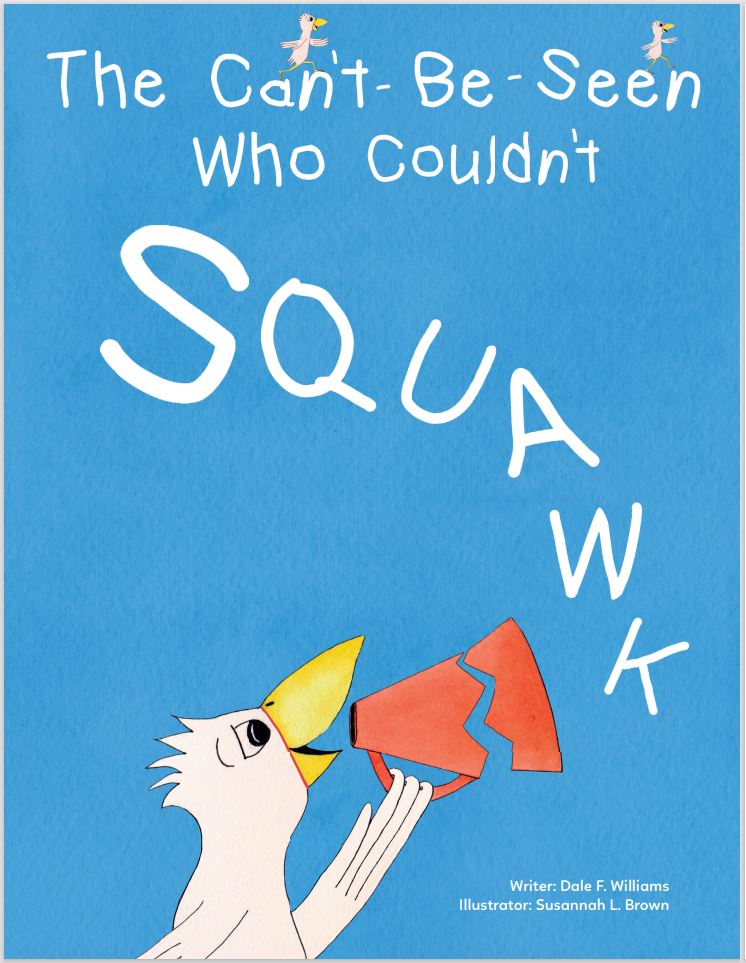
A book about a character experiencing this emotional succession can potentially help the stuttering child realize he or she is not alone, and that support exists. In addition, it can teach other children the importance of accepting those unlike themselves. However, the book’s effectiveness is evident only if its main themes are absorbed.
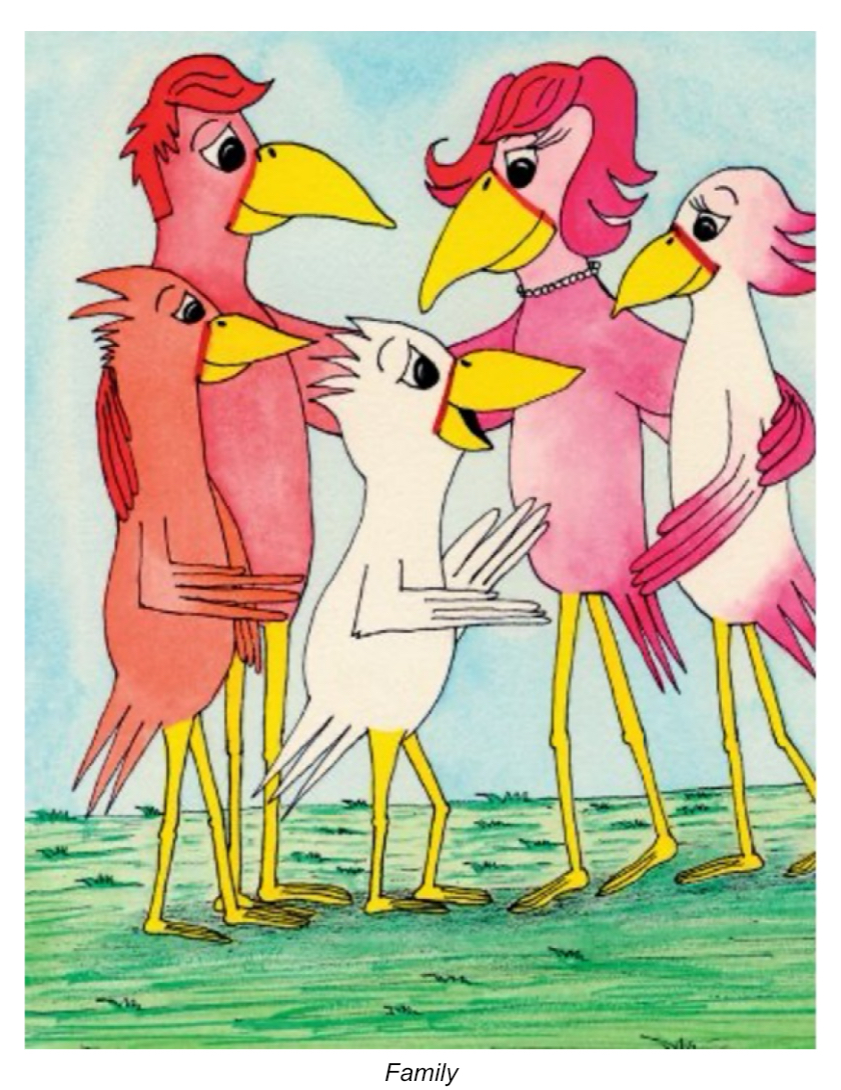
The purpose of the study was to determine whether repeated readings of The Can’t-Be-Seen Who Couldn’t Squawk can help children understand the book’s main themes of self-acceptance, empowerment, compassion (or kindness), persistence, addressing differences constructively, acceptance of others, family, friends, tolerance, and solving problems constructively.
 Family |
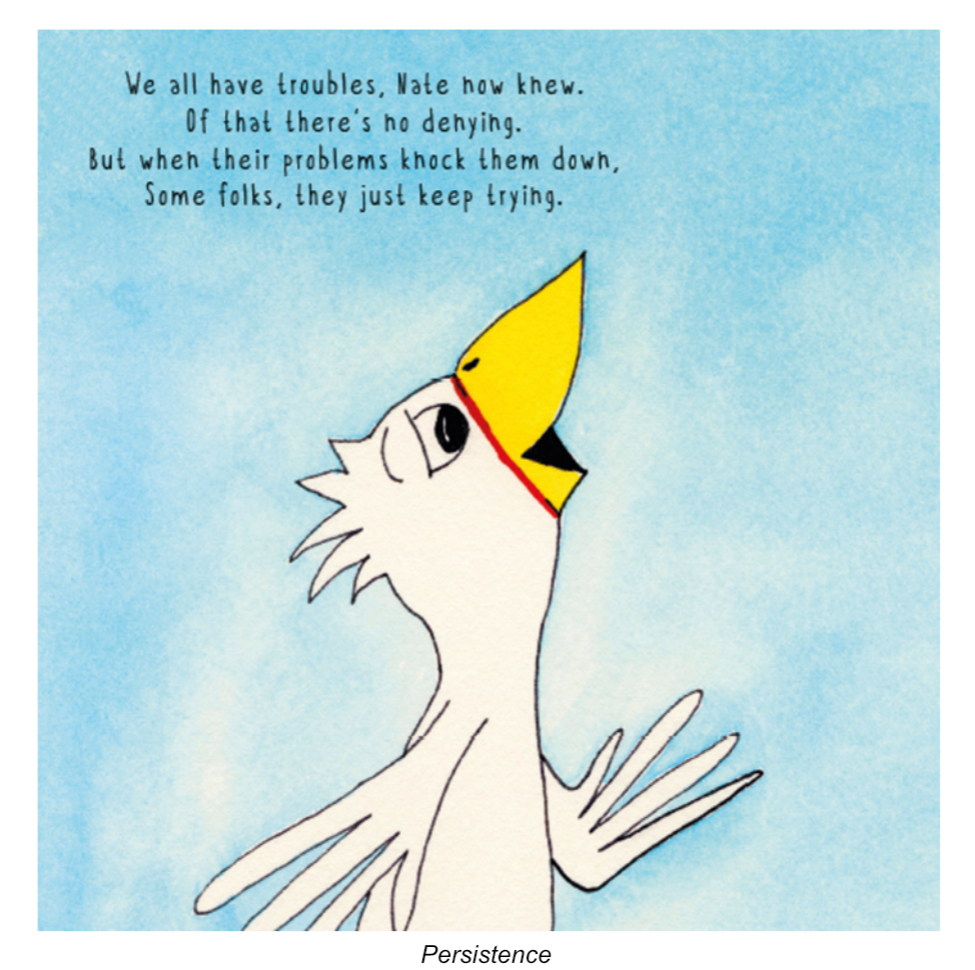 Persistance |
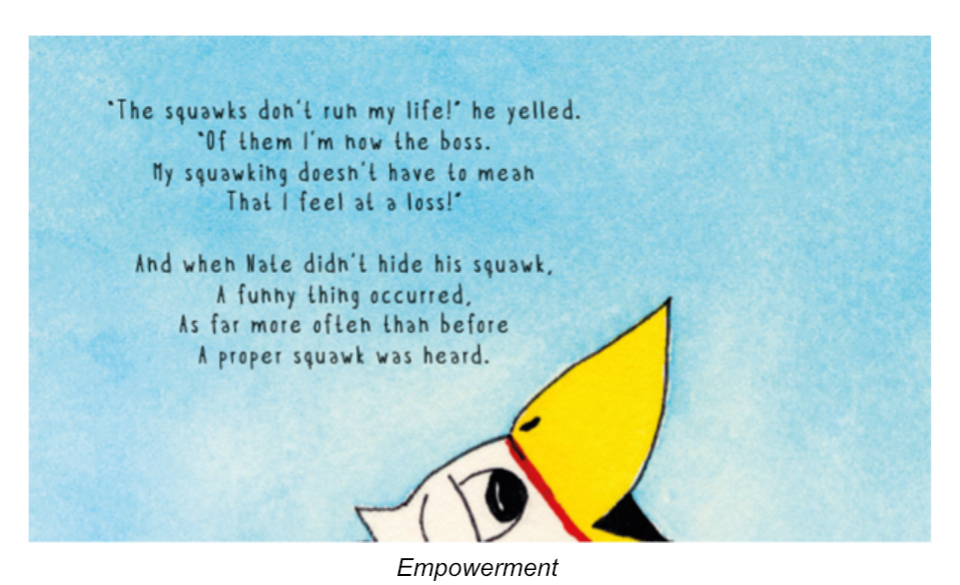 Empowerment |
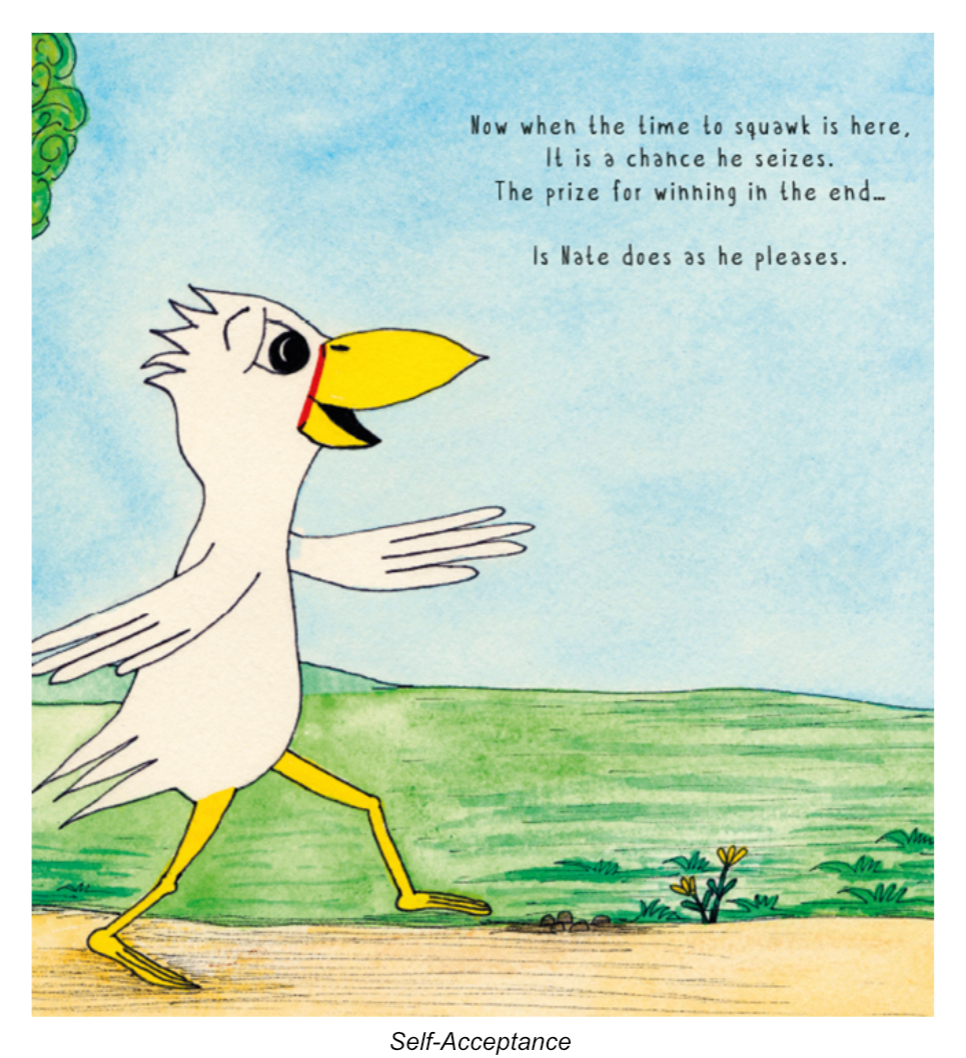 Self-acceptance |
Methods:
Nine parents of age-appropriate children, eight males and one female, were surveyed. The mean age of the children was 5.4 years. Parents who participated were given a copy of the storybook and asked to read it to their children at least three times over the span of one week. The basis for the number of readings was studies indicating that reading fluency and comprehension were greatly improved by at least three readings of a story (Padeliadu & Giazitzidou, 2018; Therrien, 2004). All children heard the story exactly three times.
After the third reading, parents were instructed to discuss with their children the ten “Questions just for fun” at the end of the book, then complete the survey. The discussion questions were comprised of the following:
- What did you like about the story?
- What was your favorite part?
- What do you like about Nate?
- Do you like Nate’s friends? What makes them good (or bad) friends?
- Would you like to be Nate’s friend? Why (or why not)?
- Would you like to live in a land that can’t be seen?
- If you lived there, what could you and your friends have done to help Nate?
- What did Nate learn?
- What did Nate’s family learn?
- What about his friends?
The survey questions asked parents to list the age and gender of their children, the number of times they read the story to them, and to rate the child’s enjoyment of the story on a 5-point scale from “not at all” to “very much”. Parents also answered yes or no to a series of questions about their child’s responses to the “Questions just for fun,” namely whether they alluded to self-acceptance, empowerment, compassion (or kindness), persistence, addressing differences, acceptance of others, family, friends, tolerance, and solving problems constructively.
Parents were also instructed to describe their child’s responses. Finally, they were asked the additional open-ended question(s), “Since hearing the story, has your child exhibited any behaviors that demonstrate changed attitudes regarding any of the items listed above? If so, what were they?”
Results:
Parents rated all nine of the children as enjoying the story “very much” (Figure 1). When discussing the questions, the children’s responses referenced all ten of the book’s main concepts. As illustrated by Figure 2, a majority of the children alluded to compassion and kindness (mentioned by 8 of them), friends (7), self-acceptance and bullying or teasing (6 each), as well as children with differences (5). Examples include:
- “He said Nate’s friends are kind, he liked this aspect of the story.” (Compassion/Kindness)
- “He recognized that you just have to be who you are.” (Self-Acceptance)
- “He was very upset about the mean friend. While reading actually at that part he said ‘that is bullying. He is not supposed to do that.’” (Bullying/Teasing)
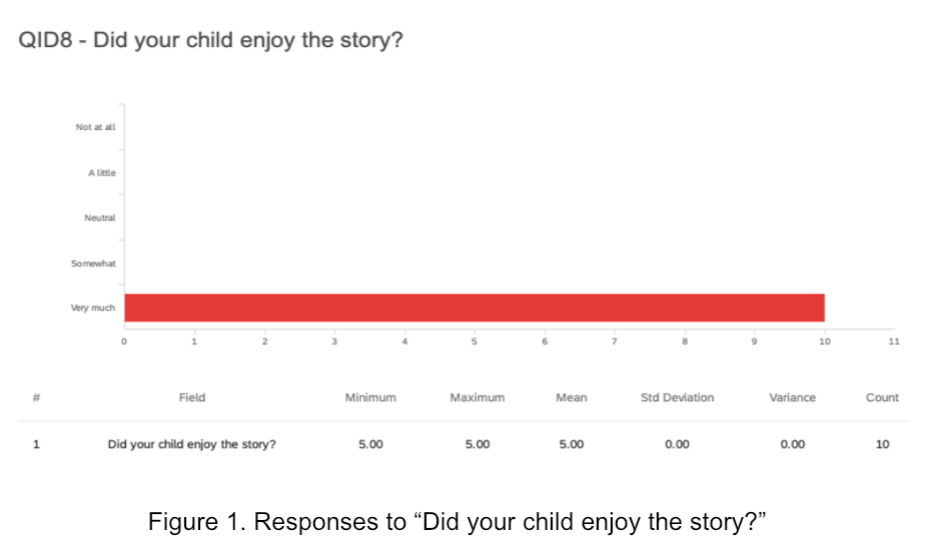 Fig 1 |
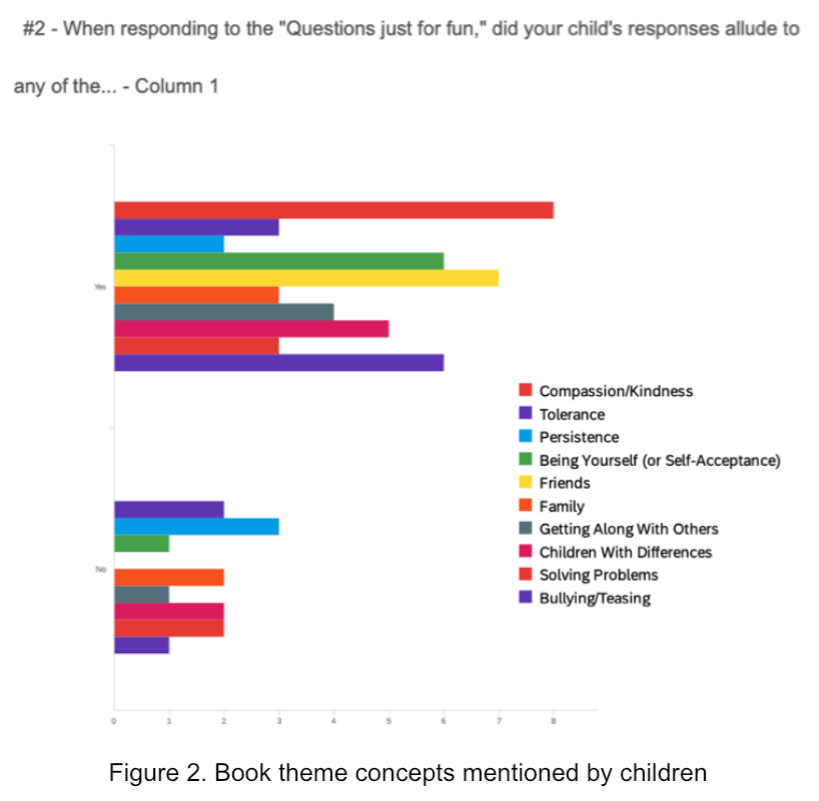 Fig 2 |
Regarding behavior change, opportunities were limited, given the small amount of time between the readings and survey completion. Still, there were three responses, including this notable one: “They definitely seem more conscious. Maybe even more accepting of themselves. That it’s ok he isn’t the best at soccer because he is the best at math.”
Discussion:
Our results indicate that repeated readings of The Can’t-Be-Seen Who Couldn’t Squawk (Williams & Brown, 2021) helped children understand the book’s main themes. Specifically, children to whom the book was read discussed the concepts of compassion or kindness, friendship, self-acceptance, bullying/teasing, and children with differences to a relatively large degree; the importance of tolerance, persistence, family, getting along with others, and problem-solving were also mentioned by multiple children.
The results show a detailed snapshot of parental reporting of their children’s attitudes at the conclusion of three readings of the story. As such, it is important not to overgeneralize the findings. For example, nothing can be claimed at this time regarding how lasting these attitudes are. Perhaps future research can assess the same perceptions over time, in particular those that were frequently mentioned by the children in this study.
References
Barton, G., Baguley, M., Kerby, M., MacDonald, A. (2019). Exploring how quality children’s literature can enhance compassion and empathy in the classroom context. In: Barton, G., Garvis, S. (eds) Compassion and Empathy in Educational Contexts. Palgrave Macmillan, Cham. https://doi.org/10.1007/978-3-030-18925-9_9
Bernard, R. F. L., & Norbury, C. F. (2023). Factors associated with symptoms of anxiety and depression in children who stutter. Language, Speech, and Hearing Services in Schools, 54(2), 535–549. https://doi.org/10.1044/2022_LSHSS-22-00086
Boyle M.P. (2018) Enacted stigma and felt stigma experienced by adults who stutter. Journal of Communication Disorders, 73, 50–61.https://doi.org/10.1016/j.jcomdis.2018.03.004.
Croft, R. L., & Byrd, C. T. (2023). Clinical and psychosocial predictors of post-event processing in adults who stutter. Journal of Speech, Language, and Hearing Research: JSLHR, 66(11), 4259–4279. https://doi.org/10.1044/2023_JSLHR-23-00245
Erickson, S., & Block, S. (2013). The social and communication impact of stuttering on adolescents and their families. Journal of fluency disorders, 38(4), 311–324. https://doi.org/10.1016/j.jfludis.2013.09.003
Howerton, C. E. (2021). Authentic representations of youth who stutter: An analysis of children’s and adolescent literature. WWU Honors College Senior Projects, 464. https://cedar.wwu.edu/wwu_honors/464
Ismail, H. M. (2023). Children’s literature: The significance and other impacts. Theory and Practice in Language Studies, Academy Publication, 13(3). https://doi.org/10.17507/tpls.1303.07
Kucirkova N. (2019). How could children’s storybooks promote empathy? A conceptual framework based on developmental psychology and literary theory. Frontiers in Psychology, 10, 121. https://doi.org/10.3389/fpsyg.2019.00121
Laiho, A., Elovaara, H., Kaisamatti, K., Luhtalampi, K., Talaskivi, L., Pohja, S., Routamo-Jaatela, K., & Vuorio, E. (2022). Stuttering interventions for children, adolescents, and adults: A systematic review as a part of clinical guidelines. Journal of Communication Disorders, 99, 106242. https://doi.org/10.1016/j.jcomdis.2022.106242
Logan, K. J. (2022). Fluency disorders: Stuttering, cluttering, and related fluency problems (2nd ed.). Plural Publishing.
Luther, Vicki L. (2023). More than words: using children’s literature to promote self-awareness in the primary grades. The Language and Literacy Spectrum, 33(1), Article 3. https://digitalcommons.buffalostate.edu/lls/vol33/iss1/3
Padeliadu, S. & Giazitzidou, S. (2018). A synthesis of research on reading fluency development: Study of eight meta-analyses. European Journal of Special Education Research, 3(4). https://doi.org/10.5281/zenodo.1477124
Spufford, F. (2002). The child that books built: A life in reading. Faber and Faber.
Therrien, W. J. (2004). Fluency and comprehension gains as a result of repeated reading: A meta-analysis. Remedial and Special Education, 25(4), 252-261. https://doi.org/10.1177/07419325040250040801
Türkili, S., Türkili, S., & Aydın, Z. F. (2022). Mental well-being and related factors in individuals with stuttering. Heliyon, 8(9), e10446. https://doi.org/10.1016/j.heliyon.2022.e10446
Williams, D. F. (2023). Stuttering perspectives: A journey through research, treatment, controversies, and personal accounts (2nd ed.). Routledge.
Williams, D. F., & Brown, S. L. (2021). The can’t-be-seen who couldn’t squawk. Brainary Publishing.

Hello Dale, Susannah, and Francesca
Well done for doing this research, and for publishing the results here.
I think that the conclusion is really important for us all to understand, and I hope that many therapists and parents buy the book.
Thank you
Hanan
We’re certainly pleased that the story’s themes were understood as intended. Thanks, Hanan. It’s always great to get your perspective.
Dale
Hello Hanan,
We truly appreciate your support. We also hope the book reaches many therapists and families who can find it helpful.
Thank you!
Francesca Cocilovo
Dale, Susannah and Francesca,
Thanks for sharing your research. I am constantly searching for books for little children that affirm stuttering and celebrate differences. I am very excited to have discovered your book and particularly grateful that it fosters self acceptance, compassion, and empowerment. Thank you,
Nic
Thanks, Nic. Please let me know how you like the story: dwilliam@fau.edu. (And if you like the artwork, I can pass that along to Susannah.)
Thank you Nic,
We are so happy that you have found this children’s book helpful. We really want to share this book with others especially children. Thank you for your comments.
Susannah Brown
Thank you, Nic!
We appreciate your kind words and are happy the book resonates with what you have been searching for.
Thanks again,
Francesca Cocilovo
Still one of my favorite books to use in therapy…the main themes and concepts are so valuable and a great springboard for meaningful discussions! – Ana Paula Mumy
Thanks, Ana Paula. I hope your clients like it. As an aside, I’ve used it with older kids too, and for much the same reason, e.g., take this home and read it and next time tell me if you think it would be a good story for young children dealing with stuttering OR next time we’ll talk about what messages there are for children who stutter OR I give them only the text and assign them to draw a picture or pictures that are age appropriate and fit the story.